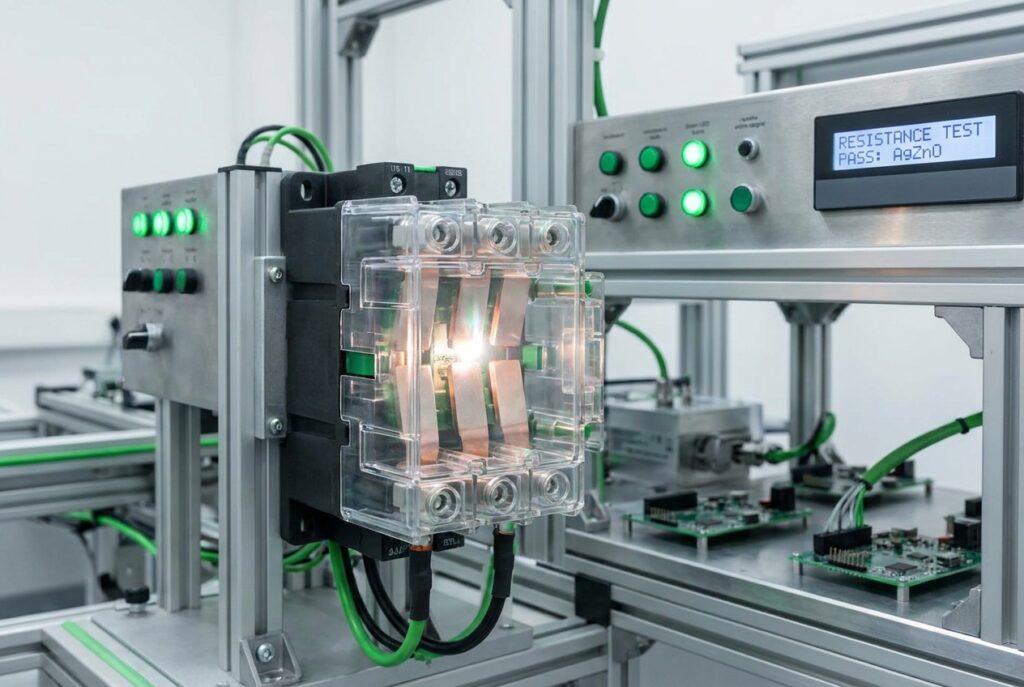
As the global electrical industry pivots toward more sustainable manufacturing practices, the search for “green” alternatives to traditional contact materials has intensified. For decades, Silver Cadmium Oxide (AgCdO) was the benchmark for anti-welding performance in AC contactors. However, the toxicity of cadmium led to the rise of Silver Tin Oxide (AgSnO2) and, more recently, Silver Zinc Oxide (AgZnO). While AgSnO2 is well-known, AgZnO is increasingly recognized as a superior, eco-friendly champion for specific high-power AC applications.
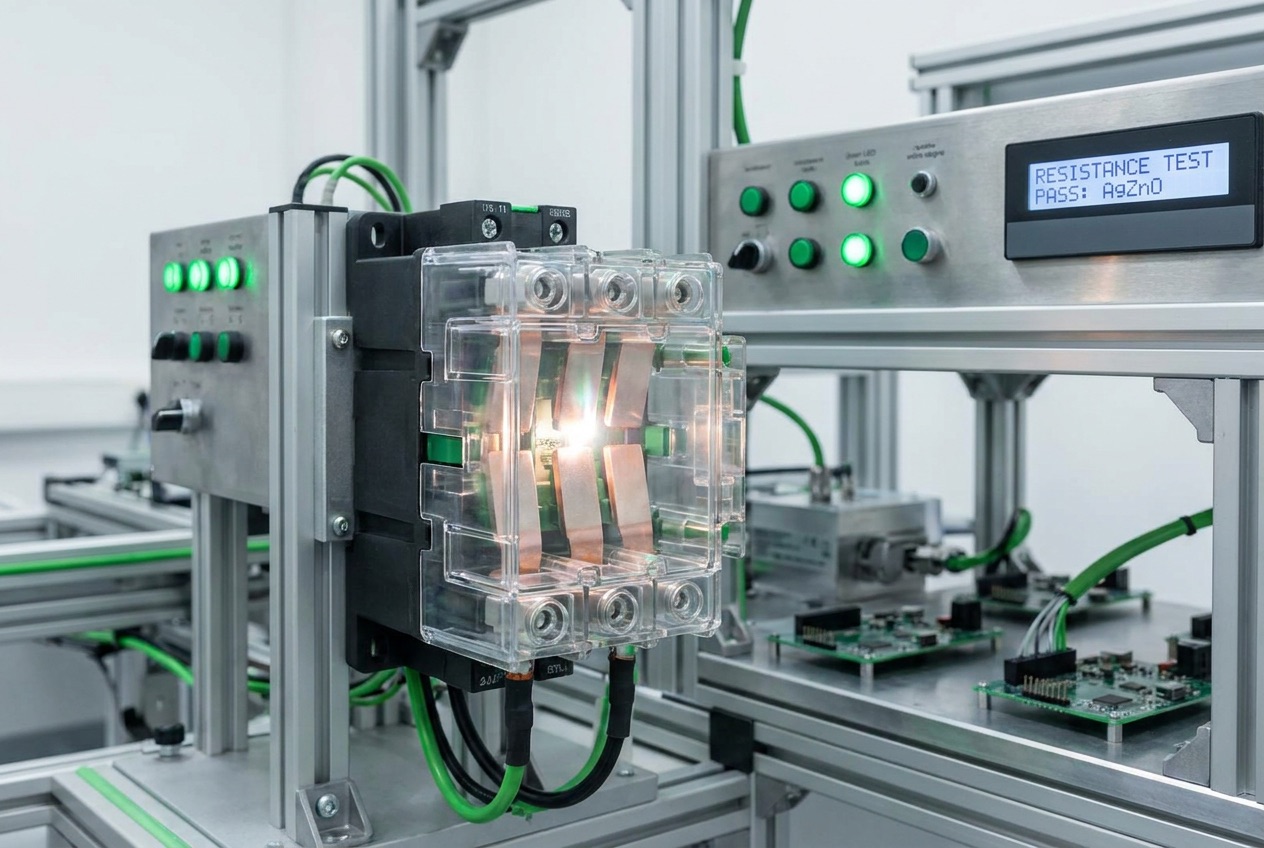
The Chemistry and Microstructure of AgZnO
AgZnO is a metal-oxide composite where fine particles of Zinc Oxide (ZnO) are dispersed within a Silver (Ag) matrix. ZnO is a wide-bandgap semiconductor with a high melting point and excellent thermal stability. In the context of an electrical contact, these ZnO particles serve two primary functions: they prevent the contacts from welding (anti-welding) and they assist in arc quenching.
At Contactrivets, we produce AgZnO through internal oxidation or powder metallurgy. The internal oxidation process is particularly effective for AgZnO, as it results in a very fine, uniform distribution of ZnO particles. This “dispersion strengthening” not only improves the material’s resistance to arc erosion but also increases its hardness, making it more durable under the high-frequency switching seen in industrial contactors.
Arc Quenching and Weld Resistance in AC Loads
When an AC contactor opens under load, an arc is formed. The intense heat of this arc melts a small portion of the silver on the contact surface. As the current passes through zero and the arc is extinguished, this molten silver can bridge the gap and fuse the contacts together—this is a “weld.”
AgZnO excels at preventing this fusion. The ZnO particles have a high surface energy and do not wet easily with molten silver. This means that as the silver melts, the ZnO particles act as a “non-stick” barrier, preventing the formation of a strong metallic bond between the two contacts. Furthermore, ZnO has a relatively low work function, which helps to stabilize the arc and ensure it is quenched quickly at the current zero-crossing.
Comparative Analysis: AgZnO vs. AgSnO2
While AgSnO2 is the most common replacement for AgCdO, AgZnO offers distinct advantages in specific scenarios:
- Inductive Loads (AC-3/AC-4): AgZnO often exhibits lower contact resistance and less temperature rise than AgSnO2 when switching inductive loads, such as electric motors.
- Material Transfer: In some AC applications, AgZnO shows more balanced material transfer between the fixed and moving contacts, leading to a flatter wear profile over time.
- Cost-Effectiveness: Zinc is more abundant and generally less expensive than Tin or Indium (often used as a dopant in AgSnO2), making AgZnO a cost-effective high-performance alternative.
Performance in Industrial AC Contactors
In practical applications, such as motor starters and industrial relays, AgZnO contacts must handle high “inrush” currents. For example, an AC-3 motor start can involve currents 6 to 10 times the rated operating current. AgZnO’s superior anti-welding properties ensure that the contactor can reliably break these high currents without the contacts sticking.
Technical analysis of AgZnO contacts after 50,000 cycles at rated load shows that the material maintains a very uniform “frosted” appearance—a sign of even arc distribution—rather than the deep pits or “beads” often seen in lower-quality materials.
Conclusion
The move toward AgZnO is not just an environmental mandate; it is a technical upgrade. By leveraging the unique semiconductor properties of Zinc Oxide, engineers can design AC contactors that are more reliable, more efficient, and completely cadmium-free. As the industry continues to prioritize both performance and sustainability, AgZnO stands ready as the premier choice for the next generation of power switching technology.