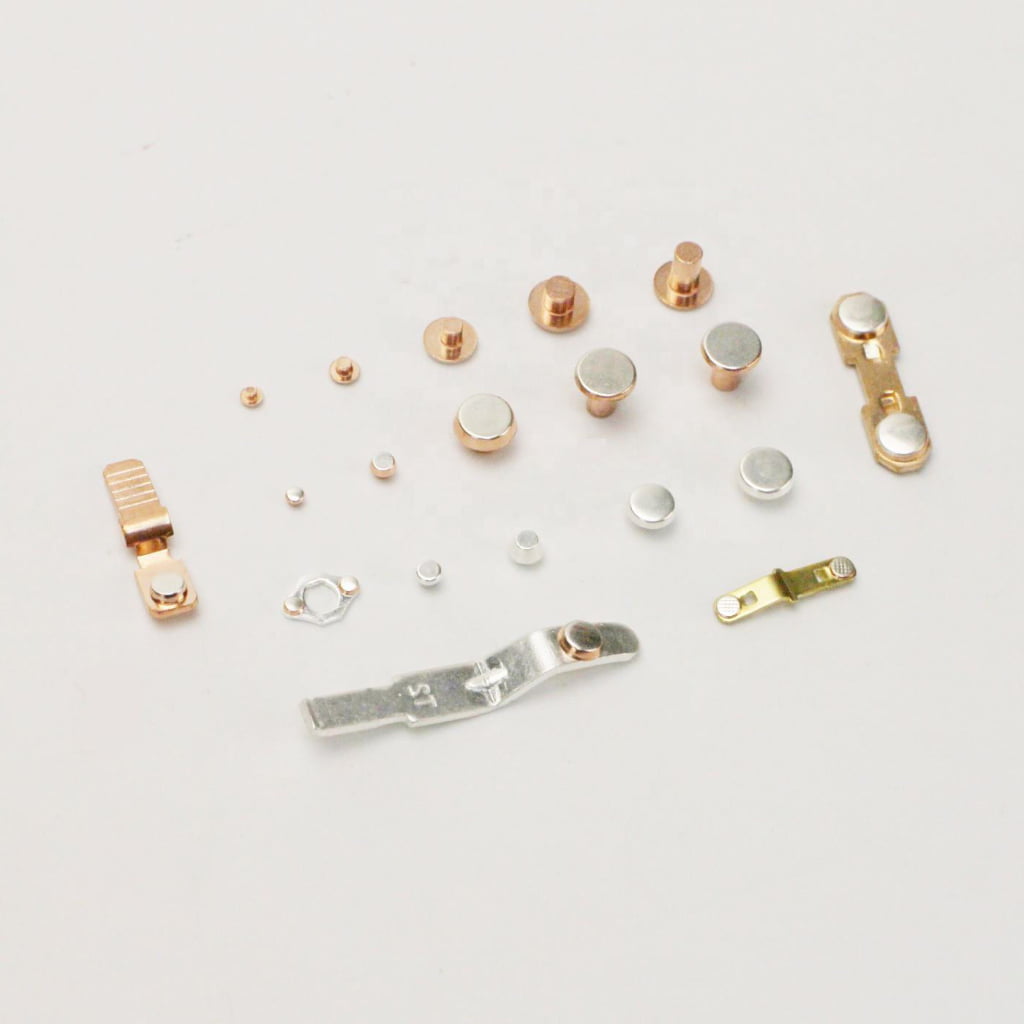
In the intricate world of electrical engineering, the choice of contact materials is a fundamental decision that dictates the reliability, longevity, and cost-efficiency of low-voltage signal switching systems. When engineers design relays, switches, and sensors for precision electronics, they often find themselves at a crossroads: should they specify solid silver (Ag) rivets or bimetal rivets? While both options serve the primary function of establishing an electrical connection, their metallurgical compositions and manufacturing processes lead to significantly different performance profiles and economic impacts. This analysis explores the technical nuances between solid silver and bimetal rivets, focusing on their application in dry circuits and low-voltage signal switching.
The Material Science of Solid Silver Contacts
Solid silver rivets are composed entirely of fine silver (typically 99.9% purity) or silver alloys like AgNi (Silver-Nickel) or AgSnO2 (Silver-Tin Oxide). Silver is the gold standard for electrical conductivity, offering the lowest electrical resistivity of all metals. In low-voltage signal switching, where the ‘wetting voltage’ is often too low to break through oxide layers, the noble nature of silver is a critical asset.

Advantages of Solid Silver
The primary advantage of a solid silver rivet is its homogeneity. Because the entire rivet is made of the contact material, there is no risk of exposing a base metal even under conditions of extreme mechanical wear or heavy arcing (though arcing is minimal in signal switching). Furthermore, solid silver rivets provide a consistent thermal path, which can be beneficial in high-frequency signal applications where impedance must be strictly controlled.
Disadvantages and Cost Constraints
The most glaring drawback is cost. As a precious metal, silver’s price is subject to global market volatility. In a solid rivet, a significant portion of the material is ‘hidden’ within the shank and the clinch, where it contributes nothing to the electrical contact interface. From an engineering efficiency standpoint, using solid silver for the structural portion of the rivet is often considered ‘material waste.’
Bimetal Rivets: Engineering the Composite Solution
Bimetal rivets, also known as composite rivets, represent a more sophisticated approach to contact design. These rivets consist of a silver or silver-alloy ‘cap’ cold-welded onto a base metal ‘shank,’ typically made of high-conductivity copper (C1100). The manufacturing process involves advanced cold-heading techniques where the two metals are bonded at the molecular level without the need for brazing or soldering.
The Mechanics of the Bimetal Bond
The integrity of a bimetal rivet depends on the quality of the cold-weld. During the heading process, the silver layer and the copper shank are subjected to extreme pressure, causing the atoms at the interface to interdiffuse. This creates a bond that is mechanically stronger than the individual metals. For signal switching, this bond must be void-free to ensure consistent electrical resistance.
Advantages: Material Savings and Mechanical Strength
The primary driver for bimetal rivets is economic. By replacing the silver in the shank with copper, manufacturers can reduce silver consumption by 50% to 80%, depending on the rivet’s dimensions. In large-scale production, this translates to massive cost savings without compromising the contact interface’s performance. Additionally, copper shanks often provide better ductility for clinching, reducing the risk of stress cracks during the assembly of the relay spring or terminal.
Performance in Low-Voltage Signal Switching
In ‘dry circuit’ conditions (typically <100mV and <10mA), the contact performance is dominated by the surface chemistry of the interface. Since both solid and bimetal rivets use the same silver-based surface, their initial contact resistance (Rc) is virtually identical.
Thermal Dissipation and Signal Integrity
In signal switching, heat generation is rarely an issue. However, in applications where the contact might occasionally handle ‘wet’ loads (power switching), the bimetal rivet’s copper shank actually offers superior thermal conductivity compared to some silver alloys, helping to dissipate heat more effectively from the contact face.
Wear Characteristics and Lifetime
For low-voltage signals, mechanical wear is the primary failure mode rather than electrical erosion. As long as the silver cap thickness on a bimetal rivet is engineered to exceed the predicted mechanical wear over the device’s lifecycle (e.g., 100,000 operations), the bimetal rivet will perform identically to a solid one.
Cost-Benefit Analysis: The Tipping Point
When deciding between solid and bimetal, the ‘tipping point’ is usually determined by the volume of production and the physical size of the rivet.
1. Small Rivets (<1.5mm diameter): The complexity of manufacturing a bimetal rivet at this scale may outweigh the silver savings. Solid rivets are often preferred for ultra-miniature applications.
2. Medium to Large Rivets (>2.0mm diameter): The silver savings become substantial. Bimetal rivets are the industry standard for automotive and industrial relays.
3. Volatility Hedge: Bimetal rivets provide a buffer against silver price spikes. Since the majority of the rivet’s mass is copper, the overall price per thousand units remains more stable.
Conclusion: Selecting the Right Contact for Modern Electronics
For engineers designing low-voltage signal switching systems, the choice between solid silver and bimetal rivets is not just about performance, but about sustainable engineering. While solid silver offers simplicity and a ‘failsafe’ wear margin, bimetal rivets provide a high-performance, cost-effective alternative that aligns with modern manufacturing goals. By carefully calculating the required cap thickness and considering the mechanical stresses of assembly, engineers can leverage the benefits of bimetal technology to create more competitive and reliable electrical components.