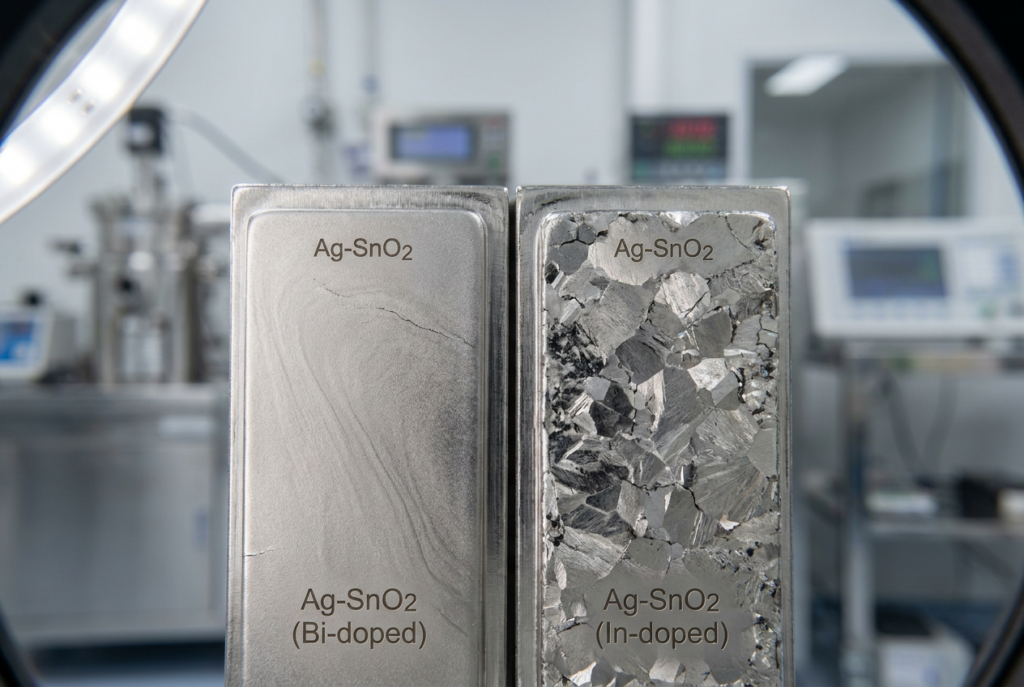
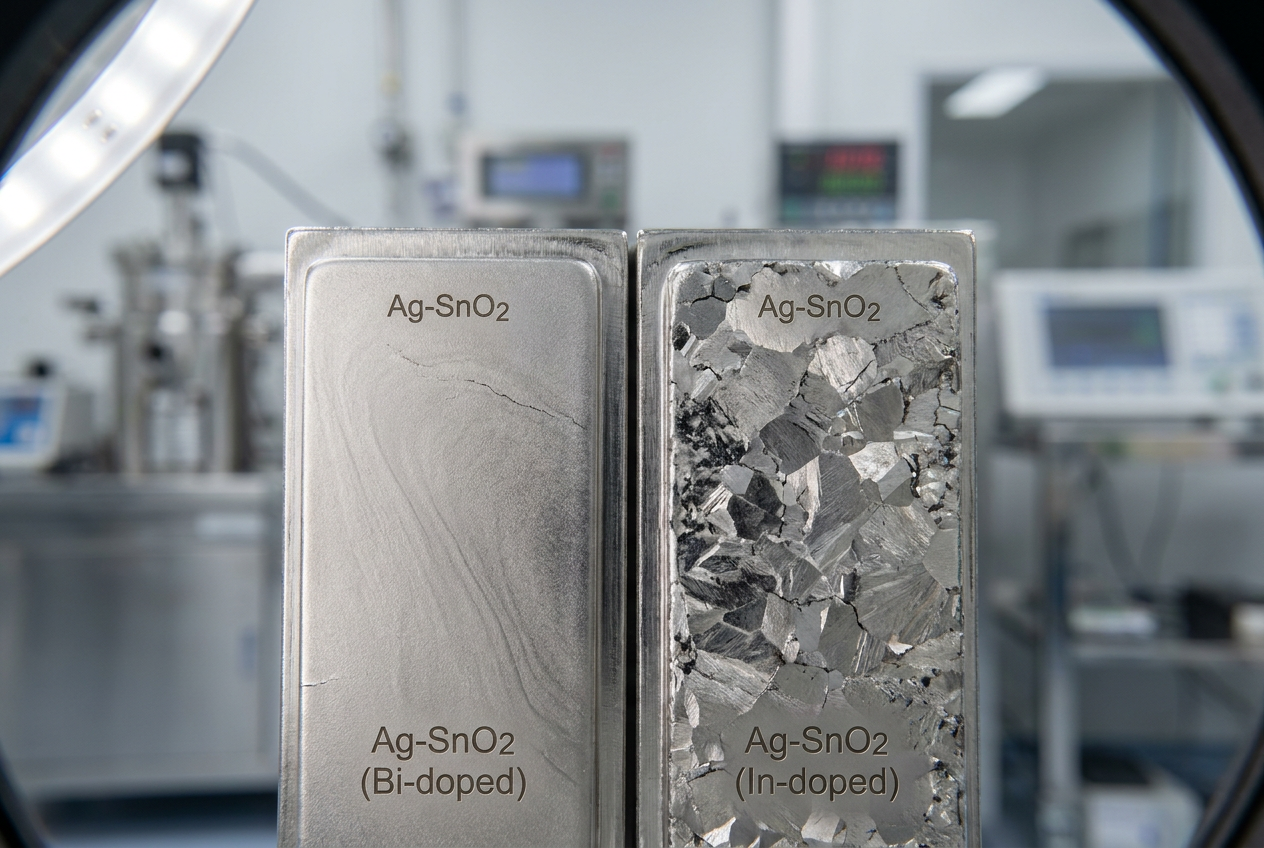
In the evolving landscape of electrical contact materials, Silver Tin Oxide (AgSnO2) has established itself as the premier environmentally friendly alternative to Silver Cadmium Oxide (AgCdO). However, the performance of AgSnO2 is heavily dependent on the additives or dopants used to refine its microstructure. Two of the most common dopants are Bismuth Oxide (Bi2O3) and Indium Oxide (In2O3). While both serve to improve the material’s switching characteristics, they offer distinct advantages depending on the application’s power requirements and switching frequency. This guide explores the technical nuances between AgSnO2-Bi2O3 and AgSnO2-In2O3 to help engineers select the optimal material for high-power switching.
Microstructure Refining and Dispersion
The primary role of a dopant in AgSnO2 is to prevent the aggregation of tin oxide particles during the manufacturing process—whether through internal oxidation or powder metallurgy.
Bi2O3 is known for its low melting point (approx. 817°C). During the sintering or oxidation phase, it acts as a flux, promoting the uniform dispersion of SnO2 within the silver matrix. This results in a refined grain structure that enhances the material’s mechanical strength and electrical conductivity. In contrast, In2O3 has a much higher thermal stability. It forms a solid solution with SnO2, which significantly increases the hardness of the contact material. The choice between Bi2O3 and In2O3 often comes down to whether the application requires a “softer” contact with better conductivity (Bi2O3) or a “harder” contact with superior wear resistance (In2O3).
Arc Mobility and Erosion Resistance
Arc erosion is the leading cause of contact failure in high-power relays and contactors. When the contacts separate under load, an electrical arc is formed, causing localized melting and evaporation of the contact material.
AgSnO2-Bi2O3 exhibits excellent arc mobility. The presence of bismuth oxide reduces the surface tension of the molten silver during arcing, allowing the arc root to move rapidly across the contact surface. This prevents deep pitting and ensures that erosion is distributed uniformly. However, at extremely high currents, the lower thermal stability of Bi2O3 can lead to increased material loss.
AgSnO2-In2O3, on the other hand, is designed for heavy-duty applications. The indium oxide dopant increases the viscosity of the molten silver pool created by the arc. This “thickening” effect helps keep the tin oxide particles suspended in the melt, preventing them from floating to the surface and forming a high-resistance oxide layer. This makes AgSnO2-In2O3 particularly effective in DC applications where material transfer is a significant concern.
Material Transfer and Anti-Welding Properties
Material transfer—the movement of metal from one contact to the other during switching—is a critical factor in the lifespan of DC relays. AgSnO2-In2O3 is widely regarded as the superior choice for minimizing material transfer. The stable In2O3-SnO2 complex creates a robust barrier that resists the directional flow of molten metal.
For AC applications, particularly those involving high inrush currents (such as motor starts or lamp loads), the anti-welding properties are paramount. AgSnO2-Bi2O3 often performs better here. The “fluxing” action of Bi2O3 ensures that the contact surface remains relatively clean, and any welds that do form are brittle and easily broken by the relay’s release mechanism.
Conclusion: Making the Choice
Selecting between AgSnO2-Bi2O3 and AgSnO2-In2O3 requires a deep understanding of the load type.
- Choose AgSnO2-Bi2O3 for AC contactors, general-purpose relays, and applications where low contact resistance and cost-effectiveness are priorities. It offers a balanced performance with excellent arc mobility.
- Choose AgSnO2-In2O3 for high-load DC circuits, automotive relays, and heavy-duty AC-3 or AC-4 switching. Its superior hardness and resistance to material transfer make it ideal for the most demanding environments.
By carefully matching the dopant to the electrical stresses of the application, manufacturers can ensure the long-term reliability and performance of their switching devices.