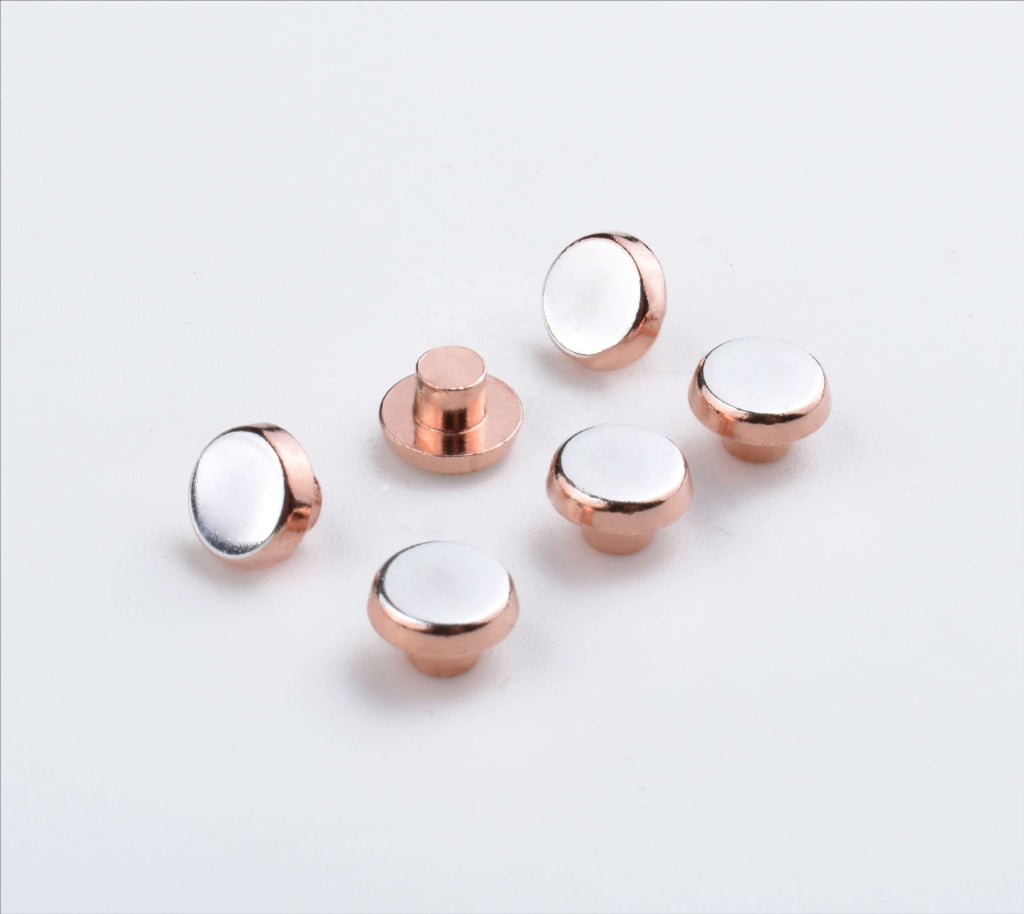
Silver Tin Oxide (AgSnO2) has emerged as the premier contact material for modern electrical switching, particularly in applications involving inductive loads. Inductive loads—such as those found in motors, solenoids, and transformers—pose a unique challenge to electrical contacts due to the high voltage spikes and sustained arcing that occur during circuit interruption. Optimizing the electrical life of AgSnO2 contacts in these environments requires a deep understanding of the material’s metallurgical structure and its response to thermal stress. This guide explores the technical strategies for enhancing the performance and longevity of AgSnO2 contacts in power relays and industrial control systems.
The Challenge of Inductive Load Switching
When an inductive circuit is opened, the magnetic field collapsing around the inductor generates a counter-electromotive force (back EMF). This results in an arc that is much more intense and longer-lasting than an arc in a purely resistive circuit. For electrical contacts, this means higher temperatures, increased material erosion, and a greater risk of contact welding. AgSnO2 is specifically designed to handle these conditions, but its efficiency depends on how it is manufactured and doped.

Metallurgical Optimization of AgSnO2
The performance of AgSnO2 is determined by the size, distribution, and concentration of the tin oxide (SnO2) particles within the silver matrix. There are two primary manufacturing routes: internal oxidation and powder metallurgy.
Fine Particle Dispersion
To maximize electrical life, the SnO2 particles must be as fine as possible and uniformly dispersed. Fine particles provide more nucleation sites for the arc, spreading the thermal energy across the entire contact surface rather than concentrating it in one spot. This prevents the formation of deep ‘craters’ and extends the mechanical integrity of the contact face.
The Role of Additives: Indium and Bismuth
Pure AgSnO2 can sometimes suffer from high contact resistance due to the formation of a stable SnO2 insulating layer on the surface. To prevent this, manufacturers often ‘dope’ the material with small amounts of Indium Oxide (In2O3) or Bismuth Oxide (Bi2O3). These additives modify the viscosity of the molten silver during arcing, allowing the SnO2 particles to move more freely and preventing the formation of a continuous insulating film. This optimization is crucial for maintaining low contact resistance over the life of the relay.
Enhancing Anti-Welding Performance
In inductive loads, the risk of ‘dynamic welding’ during contact bounce is high. AgSnO2’s superior anti-welding property comes from the fact that SnO2 does not dissolve in molten silver. During an arc event, the SnO2 particles remain solid, creating a ‘slushy’ consistency in the melt zone that is physically difficult to weld. By optimizing the volume fraction of SnO2 (typically between 8% and 12%), engineers can find the perfect balance between high conductivity and maximum weld resistance.
Electrical Life Testing and Validation
To validate the optimization, contacts must undergo rigorous electrical life testing according to standards like IEC 60947. In inductive load tests (AC-3 or DC-13 categories), optimized AgSnO2 contacts often show a 20-30% increase in switching cycles compared to standard AgCdO or non-optimized AgSnO2. These tests measure the rate of material loss and the stability of contact resistance, providing the data needed for long-term reliability forecasts.
Conclusion: The Future of High-Performance Switching
Optimizing AgSnO2 for inductive loads is a continuous process of metallurgical refinement. As industrial automation and electric vehicle systems demand higher power density and longer life from smaller components, the role of advanced AgSnO2 composites becomes even more critical. By focusing on particle size control, strategic doping, and precise manufacturing, contact manufacturers can deliver the reliability required for the next generation of power electronics.