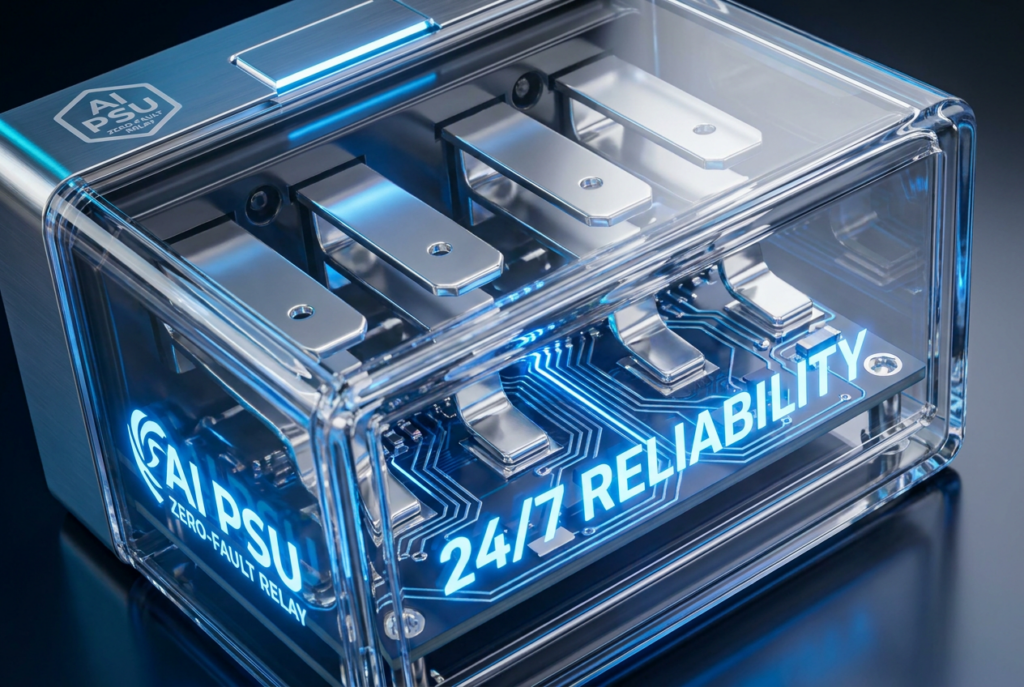
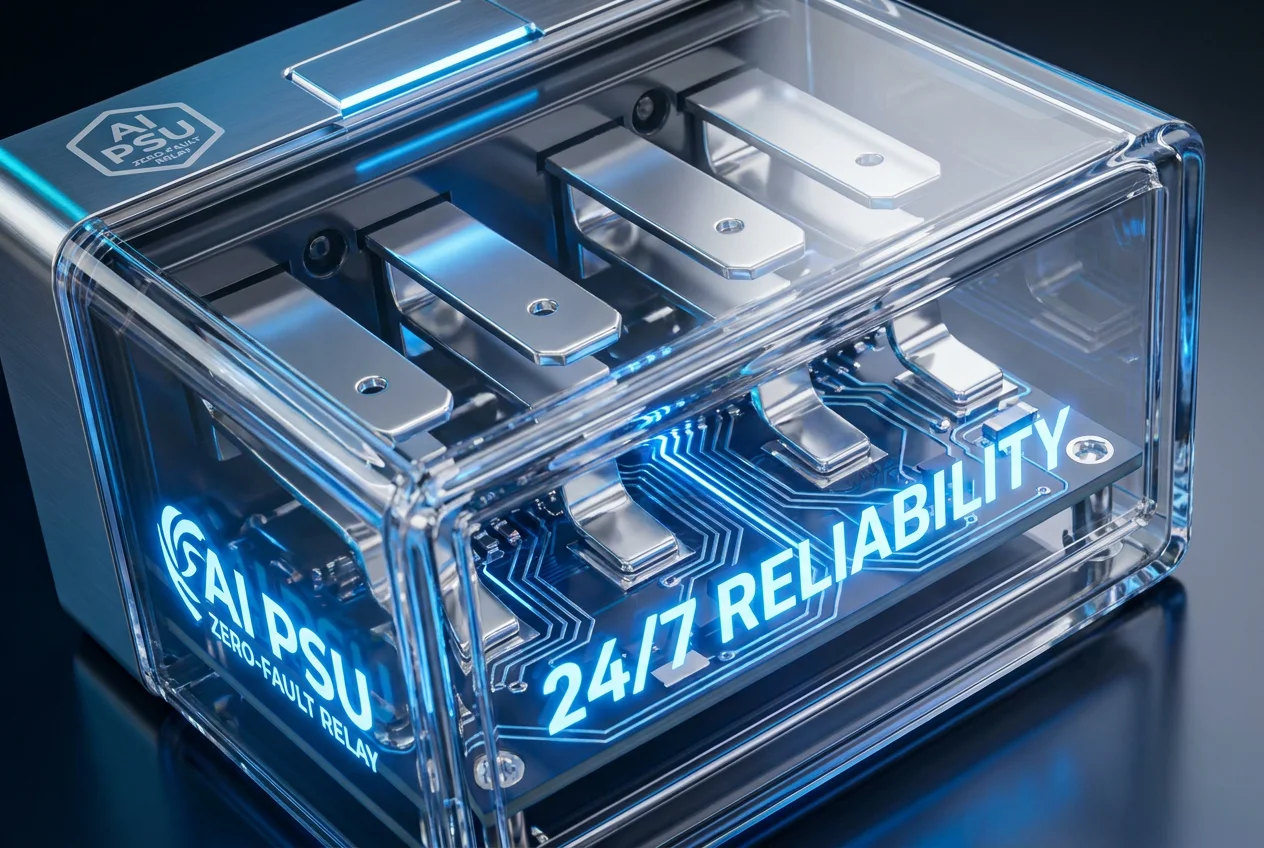
The explosive growth of AI workloads is driving unprecedented demand for high-density power in data centers. Modern AI servers, powered by GPUs that consume thousands of watts, require Power Supply Units (PSU) with absolute reliability. At the heart of these PSUs are high-performance relays that manage inrush currents and power distribution. For these components, zero-fault relay contacts are not just a preference—they are a requirement for 24/7 uptime.
The Challenges of AI Power Switching
AI data center PSUs operate under unique conditions. They must handle frequent inrush currents during server boot-up and maintain low contact resistance during continuous high-load operations. Any failure in the relay contacts, whether due to material transfer or contact welding, can lead to a localized power outage, disrupting critical AI training or inference tasks. This environment demands materials that can withstand high temperatures and rapid switching cycles without degradation.
Material Excellence: AgSnO2 and AgZnO
For data center PSUs, Silver Tin Oxide (AgSnO2) and Silver Zinc Oxide (AgZnO) are the leading material choices. AgSnO2 offers exceptional anti-welding properties, crucial for handling the capacitive inrush currents typical of modern switching power supplies. AgZnO, on the other hand, provides superior arc quenching capabilities, which helps extend the electrical life of the relay by minimizing the energy dissipated during each break operation. By utilizing these materials in bimetal rivet configurations, manufacturers can achieve the necessary performance while optimizing costs.
Technical Specifications for PSU Contacts
Engineering contacts for AI infrastructure requires meeting stringent technical benchmarks:
- Contact Resistance (Rc): Must remain exceptionally low (< 20mΩ) to prevent excessive heat buildup within the compact PSU enclosure.
- Weld Resistance: Must withstand peak inrush currents of up to 100A or more without surface fusion.
- Metallurgical Purity: Trace impurities must be minimized to prevent the formation of insulating layers that can lead to intermittent contact failure.
The Role of Automated Inspection
Given the zero-fault requirement, automated inspection during the manufacturing process is critical. At Contactrivets, we use high-speed optical inspection and X-ray cross-sectional analysis to verify the integrity of the metallurgical bond and the uniformity of the oxide dispersion. This level of quality control ensures that every contact rivet shipped to PSU manufacturers meets the rigorous demands of the AI era.
Conclusion
As AI continues to reshape the technological landscape, the infrastructure supporting it must be built on a foundation of reliability. High-performance relay contacts are a small but vital part of that foundation. By selecting advanced silver-based materials and enforcing strict quality standards, engineers can ensure their AI data center PSUs deliver the 24/7 performance the industry requires. Contact our technical team to discuss material optimization for your next-generation PSU project.