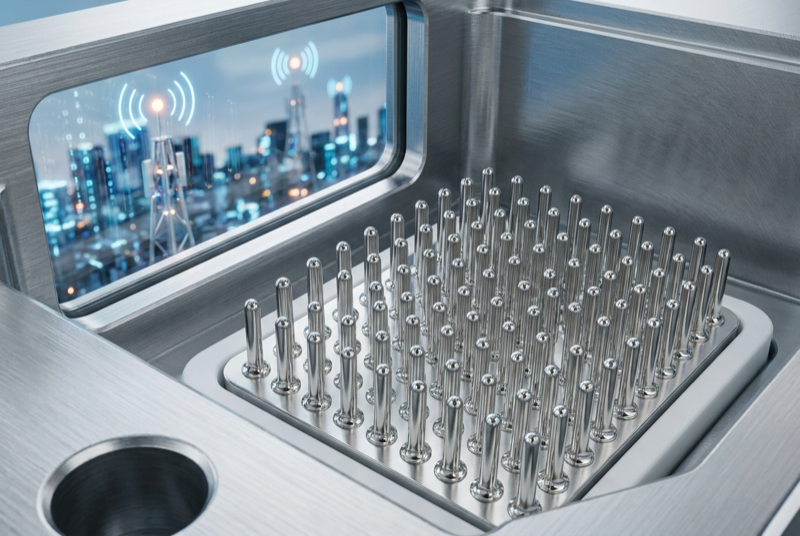

The deployment of 5G and the early development of 6G networks rely heavily on dense networks of small cells. These compact base stations are often installed in outdoor or uncontrolled environments, necessitating high levels of reliability for their internal switching components. Unlike high-power industrial applications, 5G small cell switching often involves micro-currents and high-frequency signals, which present a different set of material challenges.
Micro-Current Reliability and Signal Integrity
In 5G small cells, switches and relays are used for signal routing and power management of RF modules. At these low current levels, the formation of thin insulating films (oxides or sulfides) on the contact surface can cause signal degradation or “dry circuit” failure. To maintain signal integrity, the contact material must have excellent chemical stability and low contact resistance at low voltages.
The Case for Silver Palladium (AgPd) and Gold Plating
For high-frequency and low-current applications in telecom infrastructure, Silver Palladium (AgPd) alloys are often preferred over standard silver alloys. AgPd offers superior resistance to sulfurization, a common failure mode in urban environments. For the most sensitive signal paths, gold-plated silver rivets or solid gold-alloy contacts provide the ultimate protection against film formation, ensuring consistent performance over the 10+ year service life of a base station.
Thermal Challenges in Compact Enclosures
5G small cells are characterized by their compact size and high power density. Heat dissipation is a major concern. Any heat generated by the switching components adds to the thermal load of the entire unit. Using bimetal rivets with high-conductivity copper shanks helps pull heat away from the contact interface, preventing localized “hot spots” that could accelerate material aging or damage nearby sensitive electronics.
Environmental Resilience and Vibration Resistance
Installed on street poles, buildings, and other outdoor infrastructure, small cells are subject to constant vibration and thermal cycling. The mechanical integrity of the rivet bond and the hardness of the contact material must be carefully balanced to prevent fatigue failure or excessive mechanical wear. At Contactrivets, we conduct rigorous vibration and thermal shock testing to ensure our telecom-grade contacts can withstand the harsh realities of the field.
Conclusion
The success of the 5G and 6G revolution depends on the silent reliability of millions of small cells. By understanding the unique micro-current and high-frequency challenges of this sector, engineers can make informed decisions about contact material selection. Whether it’s AgPd for signal stability or bimetal rivets for thermal management, the right contact material is essential for a connected future. Contact us for specialized material solutions for your telecom infrastructure projects.