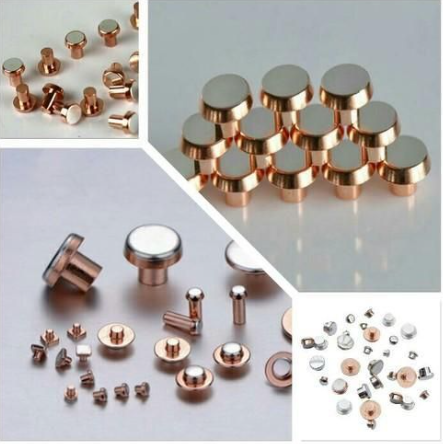
In the design of high-volume electrical switches and relays, material cost is a dominant factor. Engineers are frequently faced with the choice between solid silver rivets and bimetal rivets (a silver alloy face on a copper shank). While solid silver offers the ultimate in conductivity, bimetal designs promise significant cost savings. This technical analysis provides a Life Cycle Cost (LCC) comparison to help you make the most efficient choice for your application.
The Initial Cost Advantage of Bimetal Rivets
The primary driver for choosing bimetal rivets is the price of silver. By using a silver alloy only for the functional contact interface and a high-conductivity copper for the shank, manufacturers can reduce the total silver weight by 50% to 80% per part. In high-volume production, this translates to substantial BOM (Bill of Materials) savings. However, the initial cost is only one part of the LCC equation; one must also consider the manufacturing complexity and the potential for material waste.
Performance Trade-offs: Conductivity vs. Hardness
From a technical standpoint, solid silver rivets provide a uniform % IACS conductivity throughout the part. Bimetal rivets, while highly efficient, introduce a metallurgical bond interface between the silver and the copper. If this bond is not perfectly executed, it can introduce a small amount of interface resistance. However, advanced cold-heading technology ensures a zero-void bond that, in many cases, offers thermal dissipation superior to solid silver due to the higher thermal conductivity of pure copper.
Maintenance and Operational Costs
In terms of operational life, the “usable” silver thickness determines the electrical life of the contact. A bimetal rivet can be designed with a silver layer that matches the expected wear depth of the application. This ensures that you are not paying for “excess” silver that will never be used. In contrast, a solid silver rivet contains silver in the shank that serves only a structural purpose—a costly misuse of a precious metal. Our LCC models show that for applications with a defined cycle life, bimetal rivets offer a significantly higher ROI (Return on Investment).
Environmental Impact and Recyclability
At the end of the product’s life, recyclability becomes a factor. Solid silver rivets are easier to refine, as there is no need to separate the silver from a copper base. However, modern recycling technologies can efficiently process bimetal scrap. From an LCA (Life Cycle Assessment) perspective, the reduced demand for mined silver in bimetal designs often outweighs the slight increase in recycling complexity, making bimetal rivets the more sustainable choice for large-scale deployments.
Conclusion
The choice between solid silver and bimetal rivets is a balance of performance, cost, and sustainability. For most industrial and automotive applications, bimetal rivets provide the optimal life cycle cost by placing the precious metal exactly where it is needed. At Contactrivets, we specialize in both solid and bimetal solutions and can provide a customized LCC analysis for your specific project. Contact our engineering team today to explore how we can optimize your contact design and reduce your overall system costs.