At the microscopic level, no surface is perfectly flat. When two electrical contacts meet, they touch only at a few discrete points known as “a-spots.” This fundamental reality is the basis of Holm’s contact theory and is critical for understanding contact resistance (Rc). In this article, we delve into the science of surface roughness and its profound impact on the electrical stability of power systems.
Understanding Constriction Resistance (Rc)
Contact resistance is not simply a property of the material; it is a function of the contact interface. Constriction resistance occurs because the current flow is “constricted” as it passes through the small a-spots. The smaller and fewer these spots are, the higher the resistance. Surface roughness plays a direct role here: a very rough surface may have fewer contact points, leading to higher constriction resistance and localized heating, which can further degrade the contact through oxidation.

The Role of Contact Pressure and Morphology
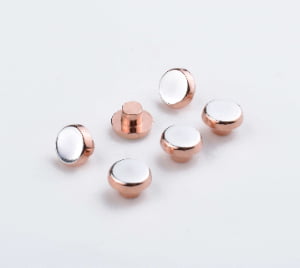
Increasing contact pressure is the most common way to reduce contact resistance. As pressure increases, the asperities (peaks) on the surface deform plastically, increasing the size and number of a-spots. However, the morphology of the surface—whether it is ground, polished, or electroplated—determines how effectively this pressure is converted into a stable electrical path. For silver-based contacts, maintaining a specific surface roughness can help “bite” through thin oxide layers to establish a metal-to-metal connection.
Oxide Layers and Environmental Degradation
Electrical stability is often threatened by the growth of insulating films, such as oxides or sulfides. Surface roughness can exacerbate this problem by providing “valleys” where contaminants can accumulate. In high-power applications, the heat generated by constriction resistance can accelerate chemical reactions at the interface, leading to a runaway increase in resistance and eventual contact failure. This is why material selection (e.g., using silver-nickel or silver-tin oxide) and surface treatment are so vital.
Maintenance and Polishing for Stable Performance
To ensure long-term electrical stability, mechanical polishing and proper cleaning are essential. Removing old oxide layers and smoothing out pitted surfaces restores the contact interface. However, over-polishing can sometimes be detrimental if it removes the hard-wearing outer layer of a composite contact. Engineers must balance the need for a clean surface with the preservation of the contact’s structural integrity.
Conclusion
The science of contact resistance is a blend of mechanical engineering, metallurgy, and physics. By understanding how surface roughness affects the flow of electricity at the microscopic level, engineers can design more reliable and efficient switchgear. Whether it’s through selecting the right silver alloy or implementing a rigorous maintenance schedule, managing the “a-spots” is the key to electrical stability.