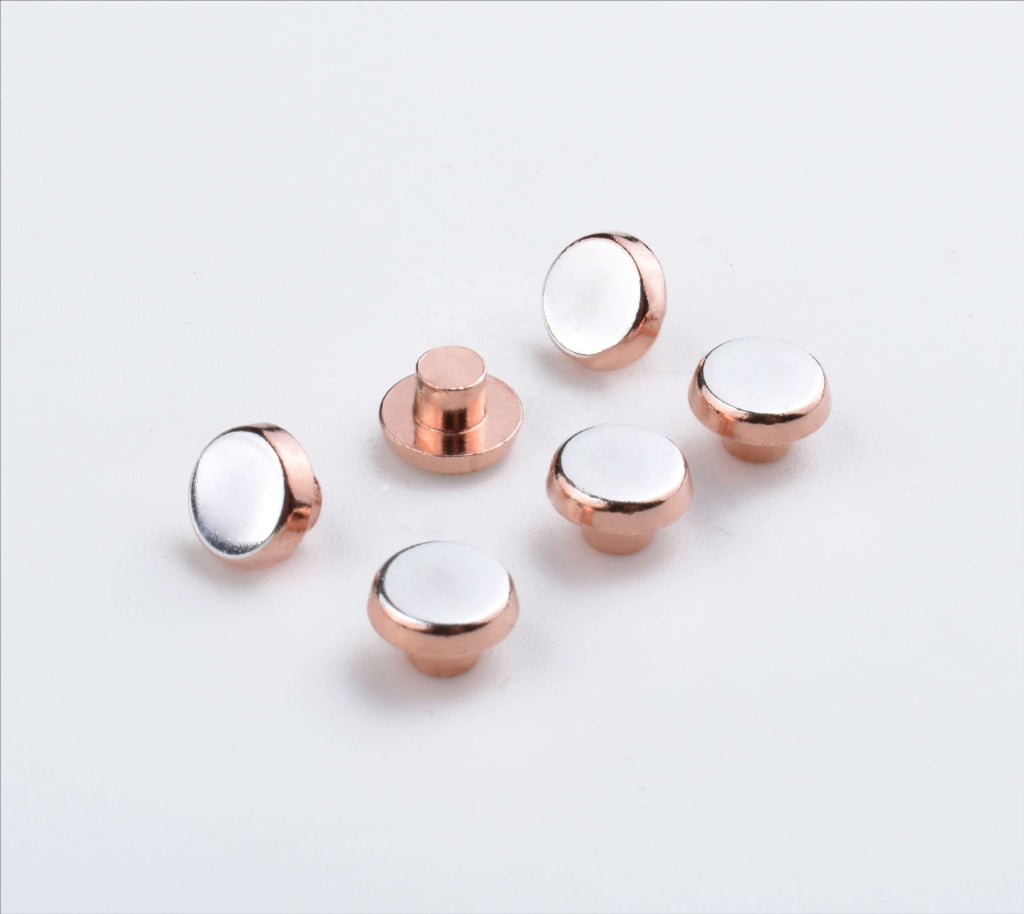
In the field of electrical contacts, contact resistance (Rc) is the most critical performance metric. While material selection and contact force are well-understood factors, the role of surface roughness is often overlooked. However, at the microscopic level, the interface between two contacts is not a continuous plane, but a collection of “a-spots” where the actual electrical conduction occurs. Understanding the non-linear relationship between surface finish and resistance is key to ensuring stable performance.
The Micro-Topology of a Contact
No matter how smooth a contact surface appears to the naked eye, it is composed of microscopic peaks and valleys. When two contacts meet, they only touch at the highest peaks, or asperities. The sum of these individual contact points makes up the true electrical contact area, which is only a fraction of the apparent mechanical contact area. As surface roughness increases, the number and size of these a-spots change, leading to a non-linear increase in resistance.
Constriction Resistance and Film Resistance
Total contact resistance is the sum of constriction resistance and film resistance. Constriction resistance occurs as current is forced to flow through the narrow a-spots. A rougher surface often has fewer, smaller a-spots, significantly increasing this constriction. Film resistance is caused by oxides or contaminants that accumulate in the valleys of a rough surface. A smoother surface finish helps minimize the areas where these films can form, ensuring a more stable electrical path over time.
Optimizing Surface Finish: Ra and Rz
For high-reliability contacts, we monitor surface roughness parameters like Ra (arithmetic average) and Rz (mean peak-to-valley height). While a very smooth finish (low Ra) minimizes initial resistance, a slightly “textured” surface can sometimes be beneficial in applications with a sliding or wiping action, as it helps trap and move wear debris away from the active contact points. At Contactrivets, we use precision cold-heading and finishing processes to achieve the optimal surface profile for each specific application.
The Impact of Arc Erosion on Roughness
It’s important to remember that the surface roughness of a contact is dynamic. Each arcing event melts and reformats the surface, typically increasing its roughness over the lifecycle. Materials like Silver Tin Oxide (AgSnO2) are designed to maintain a relatively stable surface profile even under severe arcing. By monitoring Vickers hardness and microstructural stability, we can predict how the surface finish—and thus the contact resistance—will evolve over millions of operations.
Conclusion
Surface roughness is a fundamental determinant of electrical efficiency. By moving beyond a “smooth is better” mentality and engineering the micro-topology of the contact surface, engineers can achieve significant improvements in reliability and performance. Whether you need a mirrored finish for micro-current signals or a specific texture for industrial relays, Contactrivets has the analytical tools and manufacturing precision to deliver. Contact us today for a technical review of your contact surface requirements.