Types of Electrical Contacts for Relays, Switches & Breakers (2026 Guide)
Electrical contacts are the current-carrying interfaces that make or break electrical circuits in relays, switches, contactors, and circuit breakers. The type of contact—its shape, material, and mounting method—directly determines the device’s switching performance, electrical life, and reliability.
Whether you are designing a new relay, specifying electrical contacts for production, or evaluating contact materials for an upgrade, understanding the different contact types and their respective advantages helps you make the right engineering decision.
In this guide, we break down the main types of electrical contacts used across the switching industry: their construction, typical applications, and selection criteria.
—
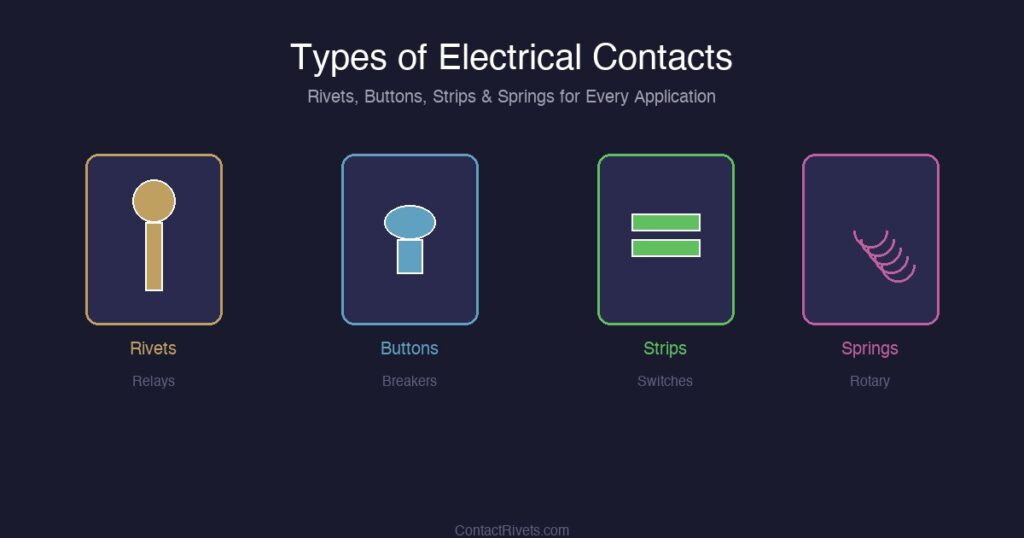
Contact Rivets
Contact rivets are the most widely used contact form in power relays, contactors, and switches. Their rivet geometry allows automated installation by staking or welding onto carrier blades, springs, or terminals.
Solid Contact Rivets
Solid rivets consist entirely of a single silver alloy from the contact face through the shank. They offer maximum electrical and thermal conductivity, making them ideal for high-current applications.
Best for: Circuit breakers, heavy-duty contactors, high-current switches.
Materials: Pure silver, AgNi, AgSnO₂, AgW.
Bimetal Contact Rivets
Bimetal rivets place a silver alloy face on a copper, brass, or steel base. They offer 60–80% cost savings over solid rivets while maintaining excellent switching performance.
Best for: Automotive relays, appliance switches, power relays, general-purpose contactors.
Common combinations: AgSnO₂/Cu, AgNi/Cu, Ag/Cu, AgNi/Brass.
Trimetal Contact Rivets
Trimetal rivets add an intermediate layer (typically nickel or copper) between the silver face and steel base to improve bonding and prevent diffusion.
Best for: High-reliability aerospace relays, critical industrial contactors.
—
Contact Buttons (Tips)
Contact buttons are small, round contact elements—typically 2–12 mm in diameter—that are welded or brazed onto carriers. They are common in circuit breakers and high-current contactors where the contact face must be precisely positioned and securely attached.
Flat Buttons
Flat contact buttons provide a large, uniform contact area with consistent pressure distribution. They are used in circuit breakers and welding equipment.
Radius (Domed) Buttons
Domed buttons create a point contact that concentrates the contact force, breaking through oxide films and ensuring low contact resistance. Common in relays and precision switches.
—
Contact Strips and Sheets
For very high-volume, cost-sensitive applications, contacts are produced as strips or sheets by cladding a silver alloy layer onto a copper or steel substrate. The composite strip is then stamped into the final contact shape.
Best for: Miniature PCB relays, microswitches, consumer electronics.
Advantages: Lowest cost per contact; compatible with automated stamping and SMD assembly.
Disadvantages: Limited to simple geometries; lower current capacity than rivets.
—
Spring Contacts and Brush Contacts
In applications requiring sliding or wiping contact motion—such as rotary switches, potentiometers, and slip rings—spring-loaded contacts or brushes are used instead of fixed rivets.
Materials: Phosphor bronze with silver or gold plating; graphite brushes for high-current DC.
—
Contact Selection by Application
| Application | Recommended Contact Type | Typical Material |
|---|---|---|
| Power relay (≤30 A) | Bimetal rivet | AgNi/Cu or AgSnO₂/Cu |
| Contactor (30–200 A) | Bimetal rivet or button | AgSnO₂/Cu or AgW/Cu |
| Circuit breaker | Button or solid rivet | AgW, AgNi, or AgC |
| Automotive relay | Bimetal rivet | AgSnO₂/Cu or AgNi/Cu |
| Signal relay (≤5 A) | Strip or small rivet | Pure Ag or AgNi |
| Microswitch | Strip or stamped contact | Ag-plated phosphor bronze |
| Slip ring / rotary | Brush or spring contact | Graphite or silver-graphite |
—
Material Selection by Contact Type
| Material | Rivets | Buttons | Strips | Best Application |
|---|---|---|---|---|
| AgSnO₂ | Excellent | Good | Limited | Inductive loads, motor controls |
| AgNi | Excellent | Good | Good | Resistive loads, general relays |
| Pure Ag | Good | Good | Excellent | Signal switching, low current |
| AgW | Good | Excellent | Poor | High-voltage breakers |
| AgC | Good | Good | Poor | DC switching, anti-welding |
| Ag-plated Cu | N/A | N/A | Excellent | Cost-sensitive, high-volume |
—
Conclusion
The type of electrical contact you choose—rivet, button, strip, or spring—depends on your application’s current rating, switching frequency, form factor, and cost constraints. For most power switching applications, bimetal contact rivets offer the best balance of performance and economy. For high-current or specialized applications, solid rivets, contact buttons, or composite strips may be the better choice.
At ContactRivets, we supply all major electrical contact types in standard and custom configurations. Contact us for material selection support and competitive quotations.
—