AgCdO to AgSnO₂ Transition: RoHS Compliance Guide (2025)
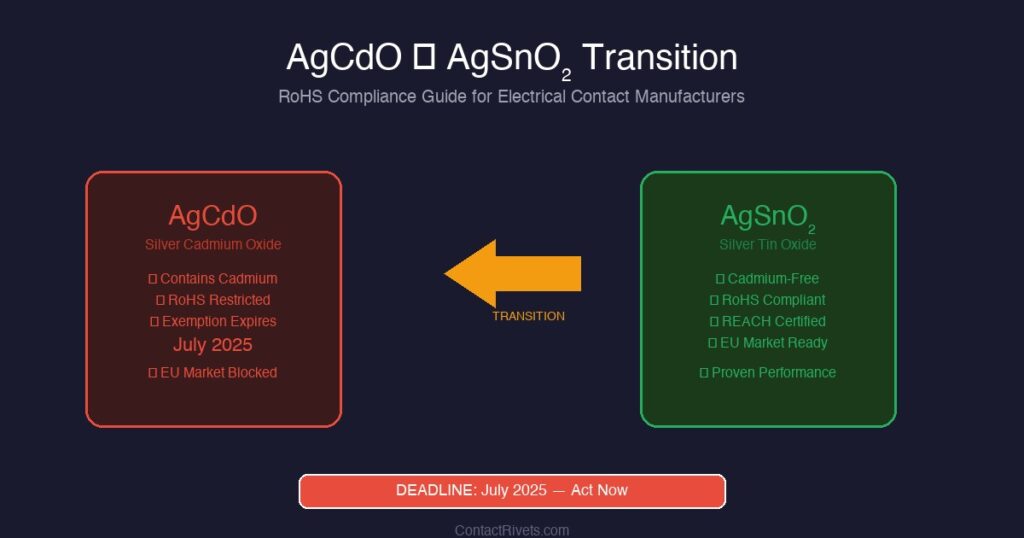
The countdown is on. With the general-use exemption for cadmium-containing electrical contacts expiring under RoHS II in July 2025, manufacturers worldwide must complete their transition from silver cadmium oxide (AgCdO) to cadmium-free alternatives—primarily silver tin oxide (AgSnO₂).
If your products still rely on AgCdO contacts, the transition is no longer optional. CE marking in the EU will require cadmium-free contact materials for new electrical and electronic equipment. The good news: AgSnO₂ has matured into a proven, performance-matched replacement that meets or exceeds AgCdO in most applications.
In this guide, we provide a practical roadmap for transitioning from AgCdO to AgSnO₂, including the regulatory timeline, material compatibility considerations, testing requirements, and steps to ensure uninterrupted production.
—
The Regulatory Timeline
RoHS I (2006)
The original Restriction of Hazardous Substances Directive (2002/95/EC) restricted cadmium, lead, mercury, hexavalent chromium, PBB, and PBDE in electrical and electronic equipment sold in the EU. AgCdO contacts received an exemption due to the lack of technically viable alternatives at the time.
RoHS II (2011/65/EU)
The recast RoHS Directive maintained the cadmium restriction but required periodic review of exemptions. The general-use exemption for AgCdO in electrical contacts (Exemption 8b) was extended multiple times but is now set to expire.
July 2025 Deadline
The general-use exemption for AgCdO electrical contacts expires in July 2025. After this date:
- New electrical and electronic equipment placed on the EU market must not contain AgCdO contacts
- Existing products already in the market are not affected (stock-in-trade provision)
- Spare parts for repair may qualify for specific repair exemptions
- Products requiring CE marking will fail conformity assessment if AgCdO is present
Post-2025 Landscape
After July 2025, AgSnO₂ and its doped variants (AgSnO₂In₂O₃, AgSnO₂Bi₂O₃) become the de facto standard for inductive and high-inrush contact applications. AgNi remains the standard for resistive and light-duty applications.
—
AgCdO vs AgSnO₂: Performance Comparison
| Property | AgCdO | AgSnO₂ | Impact on Transition |
|---|---|---|---|
| Arc erosion resistance | Excellent | Excellent | No change in contact life expected |
| Anti-welding | Excellent | Excellent | Equivalent performance under test |
| Contact resistance | Low (1–3 mΩ) | Moderate (2–5 mΩ) | May require contact force adjustment |
| Conductivity | Moderate | Moderate | Thermal design generally unaffected |
| Mechanical ductility | Moderate | Low | Higher forming forces required |
| Manufacturing | Standard | Requires optimization | Weld parameters may need adjustment |
| RoHS compliance | ❌ Non-compliant | ✅ Fully compliant | Critical for EU market access |
Key Compatibility Considerations
1. Contact Resistance:
AgSnO₂ typically exhibits 10–30% higher contact resistance than AgCdO under comparable conditions. For most applications, this difference is negligible. However, in high-current continuous-duty contactors where temperature rise is already near the limit, designers should verify thermal performance with AgSnO₂ samples.
2. Forming and Welding:
AgSnO₂’s lower ductility requires 15–25% higher forming forces during rivet heading. Resistance welding parameters (current, time, force) may need optimization to achieve consistent bond quality.
3. Contact Geometry:
In most cases, AgSnO₂ can replace AgCdO using identical contact dimensions. However, applications operating at the edge of thermal or electrical limits may benefit from slightly increased contact face area or force.
—
Transition Roadmap for Manufacturers
Phase 1: Material Qualification (Months 1–2)
- Identify all AgCdO-containing products in your portfolio that ship to EU markets.
- Select AgSnO₂ grade: Match oxide content to your application’s load type (see decision matrix below).
- Request samples from your contact supplier for qualification testing.
- Define test plan: Electrical life, contact resistance, temperature rise, welding resistance per IEC 60947 or UL 508.
Phase 2: Design Validation (Months 2–4)
- Install AgSnO₂ contacts in prototype assemblies.
- Run qualification tests and compare results against AgCdO baseline.
- Optimize contact force, geometry, or welding parameters if test results deviate from specification.
- Document design changes and update product specifications.
Phase 3: Production Transition (Months 4–6)
- Qualify manufacturing processes with AgSnO₂ (forming, welding, staking).
- Update supplier agreements and incoming inspection criteria.
- Run pilot production and monitor first-pass yield.
- Update technical documentation and customer datasheets.
Phase 4: Regulatory Compliance (Month 6+)
- Update Declaration of Conformity (DoC) to reflect cadmium-free materials.
- Conduct RoHS testing (XRF screening + wet chemistry confirmation if needed).
- Apply CE marking with updated compliance documentation.
—
AgSnO₂ Grade Selection Matrix
| Current AgCdO Grade | Recommended AgSnO₂ Replacement | Rationale |
|---|---|---|
| AgCdO 90/10 | AgSnO₂ 90/10 or AgSnO₂In₂O₃ 90/10/1 | Direct equivalent for general inductive loads |
| AgCdO 88/12 | AgSnO₂ 88/12 or AgSnO₂In₂O₃ 88/12/1 | Heavy inductive loads, high inrush |
| AgCdO 85/15 | AgSnO₂ 85/15 | Maximum arc erosion resistance |
| AgCdO for lamp loads | AgSnO₂Bi₂O₃ 90/10 | Enhanced anti-welding under peak inrush |
| AgCdO for continuous duty | AgSnO₂In₂O₃ 90/10 | Reduced temperature rise |
—
Common Transition Challenges and Solutions
| Challenge | Cause | Solution |
|---|---|---|
| Higher contact resistance | AgSnO₂ hardness | Increase contact force 10–15%; verify temperature rise |
| Welding inconsistency | Different weld parameters | Optimize resistance weld current/time; consider pre-heating |
| Forming cracks | Lower ductility | Reduce forming speed; increase heading pressure |
| Higher contact temperature | Higher bulk resistivity | Verify thermal design; increase contact area if needed |
| Short-term supply constraints | Industry-wide transition | Qualify multiple AgSnO₂ suppliers; place advance orders |
—
Conclusion
The transition from AgCdO to AgSnO₂ is not merely a regulatory requirement—it is an opportunity to future-proof your products for the global market. AgSnO₂ has proven itself as a high-performance, environmentally responsible replacement that matches AgCdO in arc resistance and anti-welding while eliminating toxic cadmium from your supply chain.
With the July 2025 deadline approaching, manufacturers who have not yet begun qualification should start immediately. The transition timeline—from material selection through design validation to production—is typically 4–6 months. Delaying beyond early 2025 risks supply chain disruption and loss of EU market access.
At ContactRivets, we specialize in AgCdO-to-AgSnO₂ transitions. We provide:
- AgSnO₂ samples in standard and custom compositions
- Material compatibility analysis for your existing designs
- Technical datasheets with RoHS and REACH certification
- Production-scale supply with consistent quality
Contact us today to begin your transition.
—