What Is a Rivet? Types, Uses & Applications (2025 Guide)
A rivet is one of the oldest and most reliable mechanical fasteners in engineering—and it remains indispensable across modern manufacturing. From the wings of commercial aircraft to the body panels of electric vehicles, rivets create permanent joints that withstand vibration, fatigue, and extreme loads without loosening over time.
Whether you are specifying fasteners for a new product, sourcing rivets for production, or simply evaluating joining methods for your next project, understanding how rivets work and which type fits your application is essential.
In this guide, we explain what a rivet is, how it works, the main types available, and where each is used across industries.
What Is a Rivet?
A rivet is a permanent mechanical fastener consisting of a smooth cylindrical shaft (the body or shank) with a rounded or countersunk head on one end. During installation, the tail end of the shaft is deformed—either by hammering, pressing, or pulling—to create a second “shop head” that clamps two or more materials together.
Once installed, a rivet cannot be removed without drilling it out or destroying the joint. This permanence is precisely what makes rivets valuable: they do not loosen under vibration, require no thread engagement, and maintain joint integrity over decades of service.
Key Characteristics
- Permanent joint: Cannot be disassembled without damage
- High shear strength: Excellent resistance to sideways forces
- Vibration resistance: No threads to back out under cyclic loading
- No heat required: Unlike welding, riveting does not distort base materials
- One or two-side access: Blind rivets install from one side; solid rivets require both
How Does a Rivet Work?
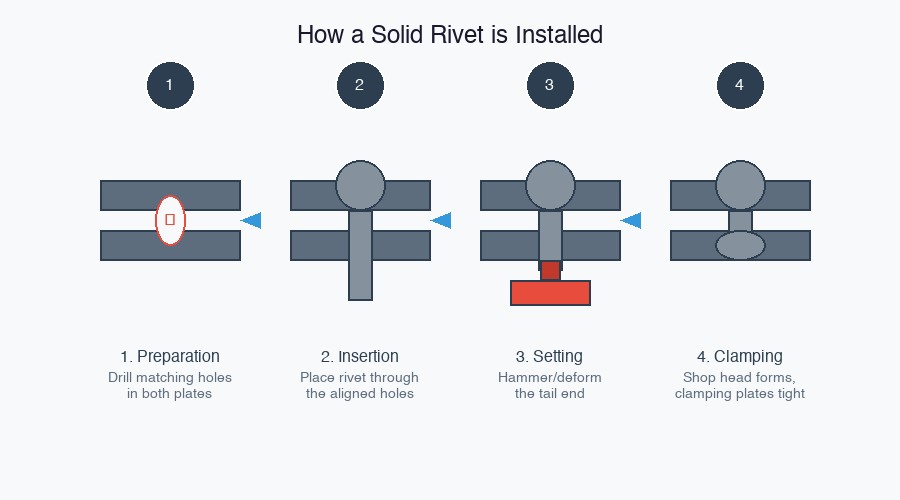
The basic principle of riveting is simple but effective:
- Preparation: A hole is drilled or punched through the materials to be joined. The hole diameter matches the rivet body diameter.
- Insertion: The rivet is placed into the hole, with the factory head resting on one side.
- Setting: The tail end is deformed to create the shop head. The method depends on rivet type:
- Solid rivets: The tail is hammered or pressed while the factory head is backed up, causing the tail to swell and form a second head.
- Blind rivets: A mandrel is pulled through the rivet body, expanding the blind side and snapping off when fully set.
- Semi-tubular rivets: A press or hammer causes the hollow tail to roll outward and flare against the material.
- Clamping: The deformed tail creates a mechanical lock that clamps the materials together with consistent force.
Main Types of Rivets
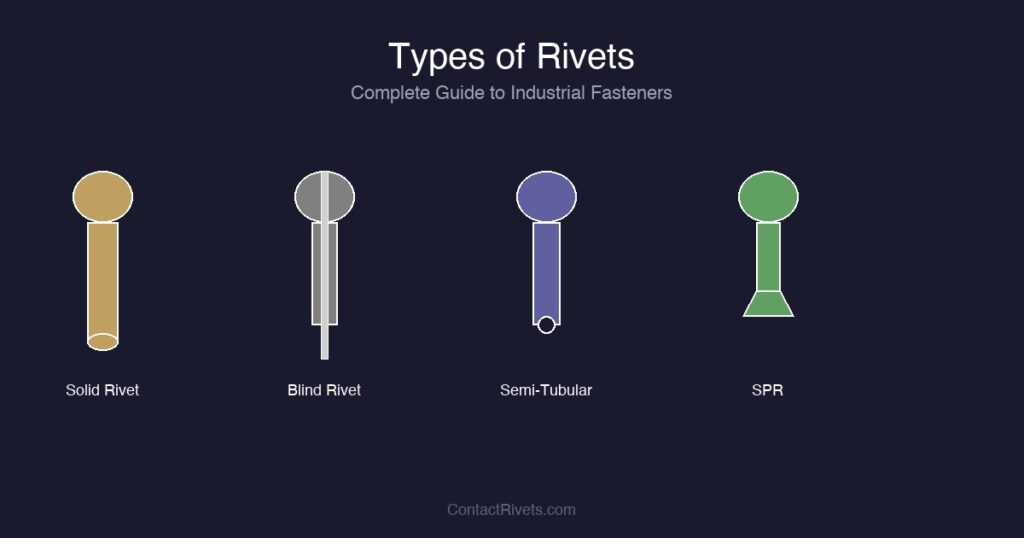
Industrial rivets fall into several categories based on structure, installation method, and application requirements. ContactRivets supplies all major rivet types for industrial applications worldwide.
1. Solid Rivets
Solid rivets are the original and strongest type. Made from a single piece of metal with a solid shaft, they require access to both sides of the joint for installation.
Key features:
- Highest shear and fatigue strength of all rivet types
- Available with round, countersunk, or brazier heads
- Installed with a rivet gun and bucking bar, or by hydraulic press
Best for: Aerospace structures, bridges, heavy machinery, railcars, and applications where joint failure is not an option.
Common materials: Aluminum (2017, 2024, 2117), steel, stainless steel, titanium, copper.
Browse our full range of solid rivets in aluminum, steel, and stainless steel.
2. Blind Rivets (POP Rivets)
Blind rivets—commonly called POP rivets after the original brand—are installed from one side only, making them ideal for enclosed or hard-to-reach assemblies.
How they work:
A mandrel runs through the hollow rivet body. When the mandrel is pulled, the blind end expands and forms a bulb. Continued pulling increases clamping force until the mandrel snaps off at a engineered break point.
Common blind rivet variants:
| Variant | Feature | Best Application |
|---|---|---|
| Open-end | Standard design; mandrel head falls out after setting | General purpose, non-critical assemblies |
| Closed-end (sealed) | Mandrel head remains captured; watertight | Marine, outdoor, HVAC, fluid containers |
| Multi-grip | Accommodates variable material thicknesses | Mixed assemblies, prototyping, repair work |
| Structural (Monobolt/Interlock) | Mandrel locks into body; high shear/tensile | Structural joints, automotive, commercial vehicles |
| Grooved | Body has grooves that bite into soft materials | Plastics, composites, thin sheet metal |
| Large flange | Oversized head distributes load over larger area | Soft or brittle materials, thin panels |
| Countersunk | Head sits flush with surface | Aerodynamic panels, visible surfaces |
Best for: Sheet metal fabrication, automotive panels, HVAC ductwork, appliances, electronics enclosures, and any joint where rear access is impossible.
Learn more in our detailed guide: Types of Blind Rivets: A Complete Guide
3. Semi-Tubular Rivets
Semi-tubular rivets have a partially hollow shaft that requires approximately 25–40% less force to set than solid rivets. The hollow end rolls outward when pressed, forming a secure clinch.
Key features:
- Lower installation force; suitable for automation
- Clean, consistent clinch formation
- Excellent for pivot points and hinge applications
Best for: Electronics, lighting fixtures, brake linings, luggage, leather goods, furniture hinges, and small appliances.
View our semi-tubular rivet catalog for standard and custom sizes.
4. Self-Piercing Rivets (SPR)
Self-piercing rivets represent one of the most significant advances in fastening technology. They require no pre-drilled hole—the rivet pierces the top sheet and flares into the bottom sheet in a single pressing operation.
Key features:
- No hole preparation needed; cycle time under 2 seconds
- Joins dissimilar materials (aluminum to steel, composites to metal)
- High joint strength with excellent fatigue life
- Ideal for automated production lines
Best for: Automotive body-in-white (BIW), EV battery trays, aluminum-intensive vehicle structures, and high-volume automated assembly.
Discover how SPR is transforming automotive manufacturing: Self-Piercing Rivets in Automotive
5. Tubular Rivets
Fully tubular rivets have a hollow shaft running the full length. They are lightweight and used primarily in light-duty applications where strength is secondary to cost and speed.
Best for: Signage, display fixtures, light consumer products, and decorative assemblies.
6. Split Rivets (Bifurcated Rivets)
Split rivets have a tail that splits into two legs. When driven, the legs spread outward and grip soft substrates.
Best for: Leather goods, textiles, wood trim, plastics, and soft materials that cannot withstand the setting force of conventional rivets.
7. Drive Rivets (Speed Rivets)
Drive rivets are installed by hammering a central pin into the body, causing the blind end to expand. No special tool is required beyond a hammer.
Best for: Signs, architectural panels, light sheet metal, and field repairs.
8. Rivet Nuts (Threaded Inserts)
Rivet nuts provide a permanent threaded insert in thin sheet materials where tapping is impractical. They combine the installation ease of blind rivets with the reusability of threaded fasteners.
Best for: Enclosures, brackets, panels, and any application requiring a removable bolt in thin-gauge material.
Explore our rivet nut product line with multiple head styles and thread sizes.
Rivet Materials: Selection Guide
Material selection directly impacts corrosion resistance, strength, weight, and cost.
| Material | Properties | Typical Applications |
|---|---|---|
| Aluminum | Lightweight, corrosion-resistant, conductive | Aerospace, automotive, marine, electronics |
| Steel (low carbon) | Economical, high strength, magnetic | Construction, machinery, general industrial |
| Stainless steel | Maximum corrosion resistance, high strength | Marine, food processing, chemical, outdoor |
| Brass / Copper | Corrosion-resistant, decorative, conductive | Electrical, plumbing, decorative hardware |
| Titanium | Exceptional strength-to-weight ratio, biocompatible | High-performance aerospace, medical implants |
| Monel / Inconel | Extreme temperature and corrosion resistance | Aerospace engines, chemical processing |
Galvanic compatibility note: When joining dissimilar metals, select rivet materials carefully to avoid galvanic corrosion. Aluminum rivets in steel structures, for example, may corrode prematurely unless properly isolated.
Need help selecting the right material? Read our Rivet Materials Guide for detailed specifications.
Key Applications by Industry
Aerospace & Aviation
Solid aluminum and titanium rivets dominate aerospace assembly. According to NASA’s fastener design guidelines, riveted joints remain preferred in many airframe applications because they avoid heat-affected zones and allow damage tolerance through multiple load paths.
Countersunk rivets create flush surfaces for aerodynamic efficiency, while protruding-head rivets provide maximum strength in internal structures.
Automotive & EV Manufacturing
Blind rivets secure interior panels, chassis components, and structural reinforcements. Self-piercing rivets (SPR) are increasingly used in aluminum-intensive vehicles and EV battery tray assembly, enabling mixed-material joining without pre-drilling. Structural blind rivets replace spot welding in certain crash-critical joints.
Construction & Infrastructure
Steel solid rivets built the world’s iconic bridges and steel-frame buildings. While high-strength bolting has largely replaced rivets in new structural steel, rivets remain specified for historical restoration, ornamental ironwork, and certain seismic applications where ductility is critical.
Electronics & Appliances
Miniature blind rivets and semi-tubular rivets assemble computer chassis, lighting housings, white goods, and electronic enclosures. The low thermal footprint of riveting protects sensitive components from heat damage.
Marine & Offshore
Stainless steel and aluminum blind rivets resist saltwater corrosion in boat building, dock construction, and offshore platform maintenance. Closed-end blind rivets prevent water ingress in hull and deck assemblies.
Heavy Machinery
Structural blind rivets and solid rivets join frames, guards, and load-bearing components in agricultural equipment, mining machinery, and material handling systems. Vibration resistance makes rivets superior to threaded fasteners in high-shock environments.
How to Choose the Right Rivet
Selecting the correct rivet involves evaluating several engineering and commercial factors:
- Joint loading: Determine required shear strength, tensile strength, and fatigue life. Structural applications may require certified structural blind rivets or solid rivets.
- Material compatibility: Match rivet material to the substrates or use a compatible grade to prevent galvanic corrosion.
- Access constraints: If both sides are accessible, solid or semi-tubular rivets may be best. For one-side-only access, use blind rivets or rivet nuts.
- Environmental exposure: Marine, chemical, or outdoor environments demand stainless steel, Monel, or properly coated aluminum.
- Installation method: High-volume production favors automated SPR or semi-tubular riveting. Field repairs may require hand-installed blind or drive rivets.
- Appearance requirements: Countersunk heads provide flush surfaces. Painted or coated rivets match aesthetic requirements.
- Standards compliance: Aerospace rivets must meet NAS, MS, or BAC specifications. Automotive applications may require OEM-specific approvals.
Still unsure which rivet fits your project? Contact our engineering team for free technical consultation.
Conclusion
Rivets are far more than simple fasteners—they are engineered joining solutions that have evolved from hand-forged iron pins to precision aerospace components and automated self-piercing systems. Understanding the differences between solid, blind, semi-tubular, and self-piercing rivets enables you to specify the optimal fastener for strength, reliability, and cost.
Whether your project demands the fatigue resistance of aerospace-grade solid rivets, the installation convenience of blind rivets, or the automation-ready speed of SPR, choosing the right type starts with understanding what each rivet can do.
Compare rivets against other joining methods: Rivets vs Welding: When to Choose Mechanical Fastening
Get a Quote for Your Rivet Requirements
At ContactRivets, we supply a comprehensive range of industrial rivets including blind rivets, solid rivets, semi-tubular rivets, self-piercing rivets, and rivet nuts. We serve aerospace, automotive, construction, electronics, and general manufacturing clients worldwide with standard and custom specifications.
Contact us today for competitive pricing, technical support, and fast delivery.
- Email: [email protected]
- Request a Quote
Related Articles
- Types of Blind Rivets: A Complete Guide
- Self-Piercing Rivets (SPR): Applications in Automotive Manufacturing
- Rivet Materials Guide: How to Choose the Right Material
- Solid Rivets vs Blind Rivets: Which Should You Choose?
- Rivets vs Welding: When to Choose Mechanical Fastening