In the intricate world of electrical engineering, selecting the right contact material is a critical decision that directly impacts the longevity, reliability, and efficiency of a device. Two of the most commonly compared materials are Silver Nickel (AgNi) and Silver Graphite (AgC). Both materials offer distinct advantages and are engineered to solve specific operational challenges. While AgNi is often the go-to for its exceptional electrical conductivity and mechanical toughness, AgC is prized for its unique lubricating properties and superior weld resistance. This technical review dives deep into the metallurgical differences between these two alloys to help engineers make an informed choice between conductivity and friction management.
AgNi: The Standard for High Conductivity and Strength
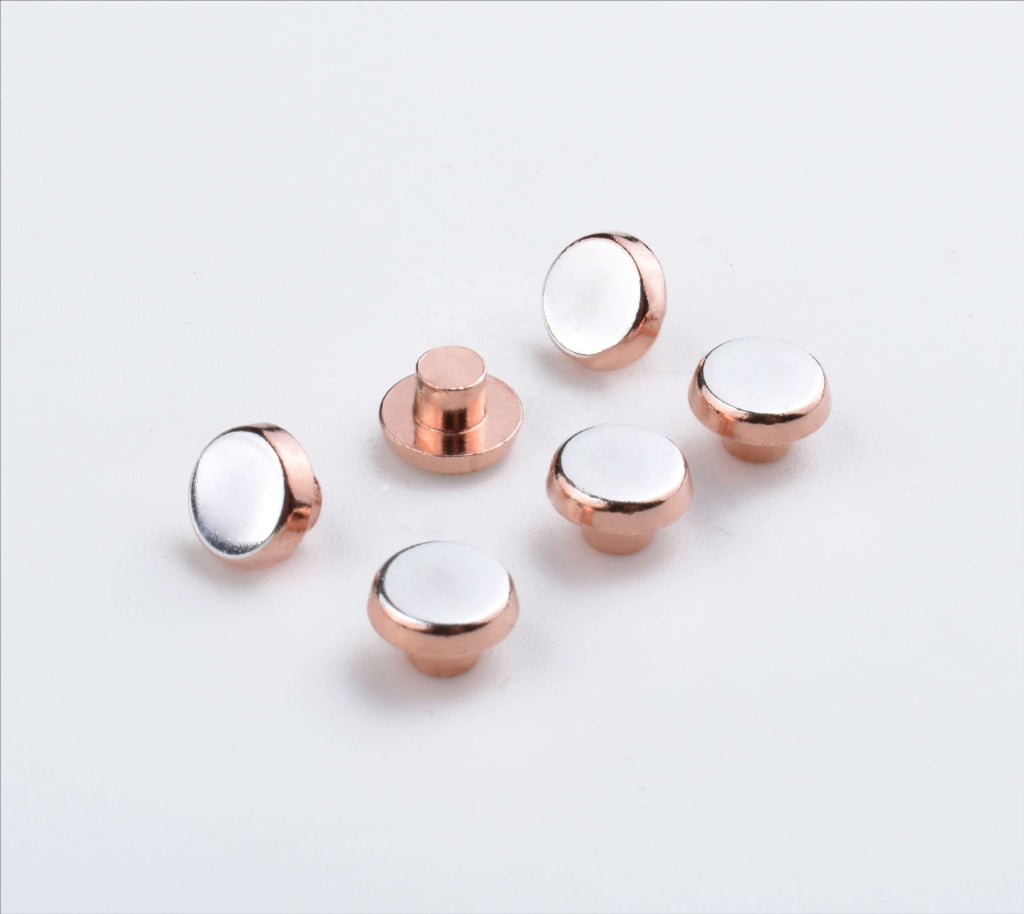
Silver Nickel (AgNi) is a pseudo-alloy produced through powder metallurgy, where nickel particles are uniformly dispersed within a silver matrix. Because silver and nickel are almost entirely insoluble in each other, the resulting material retains the high electrical and thermal conductivity of silver while gaining the mechanical strength and hardness of nickel. Common compositions range from AgNi(10) to AgNi(30), where the number indicates the percentage of nickel by weight. The primary strength of AgNi lies in its ability to resist material transfer and arc erosion under moderate electrical loads. Its high ductility also makes it easy to manufacture into various shapes, including rivets, discs, and wires, which is why it is widely used in general-purpose relays, thermostat switches, and automotive electronics.
AgC: The Solution for Welding and Friction
In stark contrast, Silver Graphite (AgC) is designed for applications where contact welding and mechanical friction are the primary concerns. Graphite, a solid lubricant, is added to the silver matrix in concentrations typically between 2% and 5%. The presence of graphite significantly reduces the coefficient of friction, making AgC an ideal choice for sliding contacts and applications with high mechanical wear. More importantly, graphite acts as a powerful anti-welding agent. During an arc event, the graphite particles prevent the formation of a continuous metallic bond between the contacts, ensuring they can always be separated. This makes AgC indispensable in safety-critical devices like circuit breakers and earth leakage protection switches, where a welded contact could have catastrophic consequences.

Comparative Analysis: Electrical Performance
When comparing electrical performance, AgNi is the clear winner in terms of raw conductivity. The silver-nickel matrix maintains a low and stable contact resistance over millions of operations, provided the current stays within its rated limits. However, as the electrical load increases and arcing becomes more intense, AgNi may eventually succumb to “pitting” or material transfer. AgC, while having higher initial contact resistance due to the presence of non-conductive graphite, maintains its integrity in high-current scenarios where arcing is unavoidable. The trade-off here is efficiency vs. safety; AgNi provides higher efficiency for low-to-medium loads, while AgC offers a safety margin against welding in high-current fault conditions.
Wear Resistance and Mechanical Life
The mechanical life of a contact is influenced by both electrical erosion and mechanical wear. In static contacts that only open and close, AgNi typically offers a longer life due to its higher hardness and resistance to deformation. However, in sliding or rotating contacts, AgNi can suffer from “galling,” where the silver surfaces cold-weld and tear each other apart. AgC excels in these sliding applications. The graphite films that form on the contact surfaces provide continuous lubrication, drastically reducing mechanical wear. This makes AgC the preferred material for commutators, slip rings, and sliding switches in power tools and industrial machinery.
Environmental Stability and Corrosion
Both materials are susceptible to environmental factors, but in different ways. Silver-nickel contacts can form nickel oxides in high-temperature or high-humidity environments, which can increase contact resistance if the contact pressure is low. Silver-graphite contacts, on the other hand, are relatively stable but the graphite can absorb moisture, which might affect the arc-extinguishing properties in some specialized applications. For most indoor industrial environments, both materials perform reliably, but in harsh outdoor or marine settings, additional plating (such as gold or tin) or the use of more specialized alloys like AgCuNi might be necessary.
When to Choose AgNi vs. AgC
The choice between AgNi and AgC ultimately depends on the specific requirements of the application. Engineers should choose **AgNi** when:
1. Low contact resistance and high electrical efficiency are paramount.
2. The mechanical load is primarily opening and closing with minimal sliding.
3. The device operates at low-to-moderate currents where welding is unlikely.
4. Ease of manufacturing and cost-effectiveness are important considerations.
Conversely, **AgC** should be selected when:
1. The application involves significant sliding motion (e.g., slip rings).
2. There is a high risk of contact welding due to high inrush currents or fault conditions.
3. Mechanical wear needs to be minimized through solid lubrication.
4. The device is a safety-critical component like a circuit breaker or protector.
Conclusion
In conclusion, neither AgNi nor AgC is universally superior; rather, they are complementary materials in the electrical designer’s toolkit. AgNi provides the electrical “muscle” for general-purpose switching, while AgC provides the “safety net” and “lubrication” for high-stress and sliding applications. By understanding the fundamental metallurgical properties of silver nickel and silver graphite, engineers can optimize their designs for the best possible balance of performance, safety, and durability. As electrical systems become more compact and power-dense, the nuanced selection of these materials will continue to be a cornerstone of reliable electrical engineering.