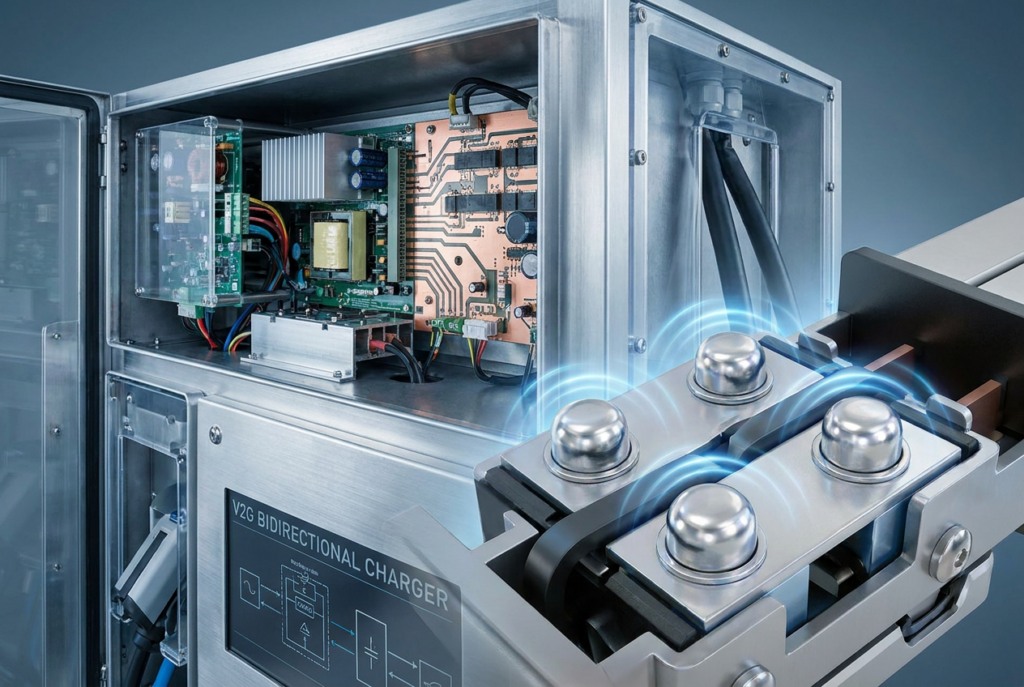
As the global energy landscape shifts toward decentralized storage, Vehicle-to-Grid (V2G) technology is emerging as a critical bridge between electric vehicle (EV) batteries and the utility grid. For electrical engineers and relay manufacturers, V2G presents a unique challenge: managing bidirectional current flow within a single switching architecture. Unlike traditional unidirectional chargers, V2G relays must handle both charging (Grid-to-Vehicle) and discharging (Vehicle-to-Grid) cycles, necessitating a more robust approach to electrical contact material selection.

The Challenge of Bidirectional DC Switching
In V2G systems, the switching components—typically high-voltage DC relays or contactors—are subject to frequent operations under varying loads. The primary technical hurdle is asymmetric arc erosion. In DC circuits, the arc tends to transfer material from one contact to the other (anode to cathode or vice-versa) based on the polarity of the current. Since V2G involves reversing the current direction, the material transfer mechanism becomes more complex. If the contact material is not optimized, this can lead to “pip and crater” formation, eventually causing contact welding or excessive contact resistance.
Why AgSnO2 (Silver Tin Oxide) is the Industry Standard
For V2G applications, Silver Tin Oxide (AgSnO2) has largely superseded Silver Cadmium Oxide (AgCdO) due to its superior weld resistance and environmental compliance (RoHS). At the metallurgical level, AgSnO2 produced via internal oxidation or powder metallurgy offers high thermal stability. The tin oxide particles act as a “skeleton” that prevents the silver from melting too rapidly during high-energy DC arcing. For V2G systems operating at 400V or 800V, we recommend AgSnO2 with a 10-12% oxide content to balance conductivity (% IACS) and arc erosion resistance.
Material Specifications and Standards
When specifying contacts for V2G relays, engineers must adhere to international standards such as IEC 61851-1 (EV conductive charging systems) and ASTM B844. Key performance metrics include:
- Contact Resistance (Rc): Must remain stable (< 50mΩ) over the lifecycle (typically 30,000+ electrical operations).
- Vickers Hardness (HV): Optimized for mechanical wear without sacrificing ductility during the riveting process.
- Thermal Conductivity: Essential for dissipating the heat generated by continuous 32A or 64A charging currents.
Optimizing the Rivet Design
Given the high cost of silver, bimetal rivets (silver alloy face on a copper shank) are the most cost-effective solution for V2G infrastructure. The copper shank provides excellent heat dissipation and electrical conductivity, while the silver alloy face ensures long-term switching reliability. At Contactrivets, we utilize specialized bonding techniques to ensure the interface between the AgSnO2 and the copper substrate remains intact even under thermal cycling extremes (-40°C to +85°C).
Conclusion
The success of V2G deployment depends on the reliability of its switching hardware. By selecting advanced AgSnO2 materials and leveraging bimetal rivet technology, manufacturers can ensure their systems meet the rigorous demands of bidirectional energy flow while maintaining safety and longevity. For custom material consultations tailored to 800V architectures, contact our engineering team today.