In the specialized world of electrical contact manufacturing, two primary processes dominate the production of silver-based rivets: Cold-Heading and Powder Metallurgy (P/M). Each method offers distinct advantages and trade-offs in terms of material properties, production throughput, and cost-effectiveness. For procurement and design engineers, selecting the right process is critical to ensuring the reliability of the final switching component. This technical guide compares these two methods to help you make an informed decision.
Cold-Heading: The Speed of Mechanical Deformation
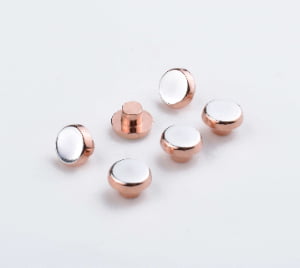
Cold-heading, also known as cold-forging, is a high-speed manufacturing process where wire stock is cut to length and then struck by a series of dies at room temperature. For contact rivets, this process is particularly efficient for producing bimetal (composite) rivets, where a silver contact face is mechanically bonded to a copper shank.
The primary advantage of cold-heading is its incredible throughput. Modern cold-heading machines can produce thousands of rivets per hour with high dimensional precision. Furthermore, the mechanical deformation involved in the process actually strengthens the material through work-hardening, resulting in a rivet with excellent structural integrity. For high-volume applications like domestic light switches and small appliance relays, cold-heading is the undisputed leader in cost-efficiency.

Powder Metallurgy: Precision and Purity
Powder Metallurgy (P/M) takes a different approach. Metal powders (e.g., silver and tin oxide) are mixed, pressed into a die at high pressure, and then sintered in a controlled-atmosphere furnace. Sintering involves heating the material below its melting point to bond the particles together.
The strength of P/M lies in its ability to create alloys with high concentrations of metal oxides (often exceeding 12% by weight) that cannot be easily produced via traditional melting or internal oxidation. P/M allows for a very uniform distribution of the oxide phase, which is critical for arc erosion resistance. However, achieving high material density is a challenge in P/M. High-quality contact rivets must achieve a relative density of >98% to ensure adequate electrical conductivity and mechanical strength.
Comparative Analysis: Density and Integrity
When comparing the two, material density and structural integrity are the most critical technical benchmarks. Cold-headed rivets, being made from solid wire or internally oxidized alloys, naturally possess 100% density. In contrast, P/M parts always have some degree of residual porosity, though advanced sintering techniques have narrowed this gap. For high-power applications where thermal conductivity is paramount, the 100% density of cold-headed contacts is often preferred.
However, for bimetal rivets, the mechanical bond created in cold-heading is subject to the quality of the “inter-locking” mechanism between the silver and copper. In P/M, the bond can be metallurgical if the layers are sintered together, potentially offering superior resistance to delamination under extreme thermal cycling.
Throughput and Procurement Considerations
From a procurement perspective, the choice is often driven by volume and material complexity. If you require standard AgSnO2(10) bimetal rivets in quantities of millions, cold-heading offers the lowest per-unit cost. If your application requires a specialized alloy with high In2O3 content or unique geometries that are difficult to forge, powder metallurgy provides the necessary flexibility, albeit at a higher price point and lower production speed.
Conclusion
Selecting between cold-heading and powder metallurgy is a classic engineering trade-off between speed and material sophistication. Cold-heading provides unmatched throughput and 100% material density, making it ideal for the vast majority of commercial and automotive applications. Powder metallurgy, while slower and more complex, is the essential process for producing the advanced, high-oxide-content alloys required for the most demanding electrical environments. By understanding these technical nuances, engineers can ensure that their contact rivets are optimized for both performance and cost.