Contact Erosion & Arc Resistance in High-Inrush Applications
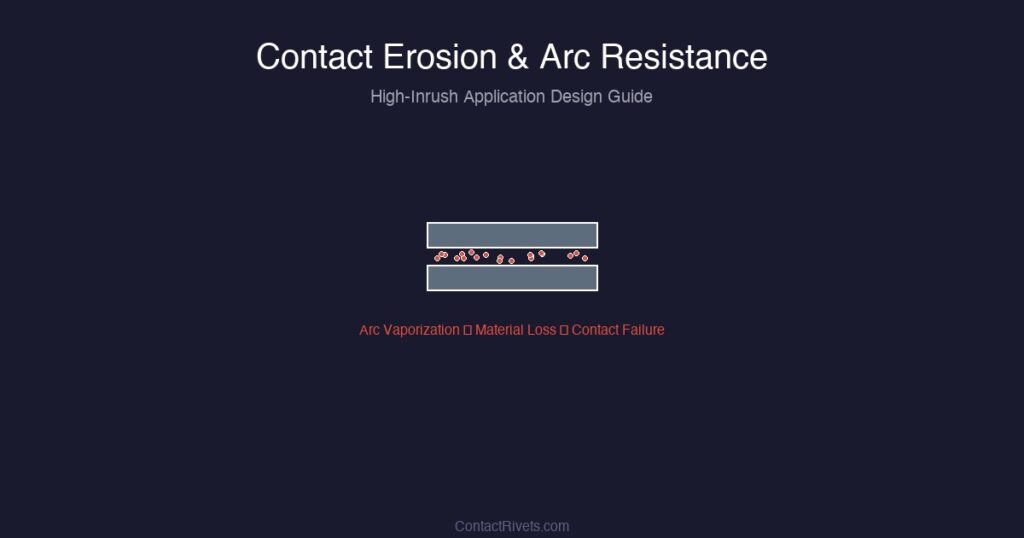
Every time an electrical switch or relay opens, an arc forms between the separating contacts. This arc reaches temperatures of 3,000–20,000°C, vaporizing and ejecting microscopic amounts of contact material. Over thousands or millions of operations, this cumulative material loss, known as contact erosion, degrades contact geometry, increases resistance, and ultimately causes device failure.
In high-inrush applications, where motor starting, lamp switching, or capacitor charging produces current surges 5–15× above steady-state values, the arc energy is significantly higher, accelerating erosion and shortening contact life.
Understanding contact erosion mechanisms and selecting contact materials with superior arc resistance is essential for designing reliable switching devices.
—
What Is Contact Erosion?
Contact erosion is the gradual removal of material from contact surfaces due to electrical arcing during switching. It manifests as material loss, material transfer, cratering, mounding, and oxide accumulation.
Erosion Rate Factors
| Factor | Effect on Erosion | Mitigation Strategy |
|---|---|---|
| Arc current | Erosion proportional to I^1.5–2.0 | Current limiting, material selection |
| Arc duration | Longer arcs = more erosion | Faster contact separation |
| Contact material | Hard oxides resist erosion better | AgSnO2, AgW instead of pure Ag |
| Load type | Inductive > resistive > capacitive | Snubbers, arc suppression |
| Switching frequency | More cycles = faster wear | Over-specify material life |
—
Arc Resistance of Contact Materials
| Material | Arc Resistance | Mechanism | Typical Life |
|---|---|---|---|
| AgW | Excellent (5/5) | Tungsten extreme hardness | 500,000+ ops |
| AgSnO2 | Excellent (5/5) | SnO2 ceramic particles resist vaporization | 300,000–500,000 ops |
| AgCdO | Excellent (5/5) | CdO vapor suppresses arc | 300,000–500,000 ops |
| AgNi | Moderate (3/5) | Nickel increases hardness vs pure Ag | 100,000–200,000 ops |
| Pure Ag | Poor (1/5) | Low melting point; soft | 20,000–50,000 ops |
—
High-Inrush Application Design Guidelines
Motor Control Contactors
Motor starting produces 6–10× full-load current inrush. Material: AgSnO2 90/10 or 88/12.
Lamp Switching
Cold filaments draw 10–15× steady-state current. Material: AgSnO2Bi2O3 90/10.
Capacitor Switching
Capacitor charging current is limited only by circuit resistance. Material: AgSnO2 88/12 or AgW.
Transformer Switching
Magnetizing inrush can reach 20–40× rated current. Material: AgSnO2 90/10.
—
Conclusion
Contact erosion is an unavoidable consequence of electrical switching, but its rate can be managed through intelligent material selection and mechanical design. For high-inrush applications, AgSnO2 offers the best balance of arc resistance, anti-welding, and cost among RoHS-compliant materials.
—