EV Charging & DC Switching: Contact Material Requirements (2026)
The rapid growth of electric vehicles (EVs) and charging infrastructure has created new demands for electrical contact materials. Unlike traditional AC switching, EV applications require contacts that can handle high DC currents, withstand frequent cycling, and resist welding under inrush conditions—all while maintaining low contact resistance and long electrical life.
Whether you are designing a DC fast charging station, an onboard charger (OBC), or a battery management system (BMS), selecting the right contact materials is critical to performance, safety, and regulatory compliance.
In this guide, we examine the unique challenges of EV charging and DC switching, and identify the contact materials best suited for these demanding applications.
—
The Unique Challenges of DC Switching
Switching DC currents is fundamentally more difficult than switching AC for three reasons:
1. No Natural Current Zero-Crossing
In AC circuits, the current passes through zero 100–120 times per second (50/60 Hz). This natural zero-crossing provides an opportunity for the arc to extinguish. In DC circuits, the current is continuous, so the arc must be forcibly extinguished by contact separation distance, magnetic blowout, or arc chutes.
2. Higher Arc Energy
DC arcs are more persistent and energetic than AC arcs of the same current. The arc voltage must exceed the system voltage before extinction occurs. For a 1000 VDC system, this requires significant contact gap and arc management.
3. Unidirectional Material Transfer
In DC switching, material transfer between contacts is unidirectional (from anode to cathode), causing asymmetric erosion and faster contact degradation compared to AC where material transfer reverses each half-cycle.
—
EV Charging System Contact Applications
Level 2 AC Charging (7–22 kW)
Level 2 chargers use AC contactors to connect the vehicle to the grid. While the load is technically AC, the inrush current during plug-in and the inductive nature of the vehicle’s onboard charger create switching challenges similar to DC applications.
Recommended materials: AgSnO₂/Cu or AgSnO₂In₂O₃/Cu bimetal rivets.
DC Fast Charging (50–350 kW)
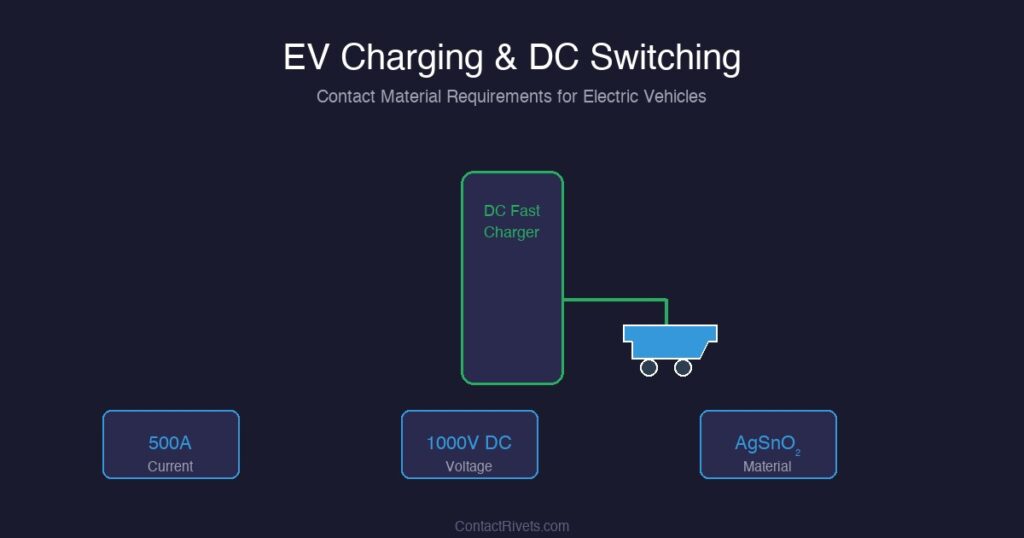
DC fast chargers bypass the vehicle’s onboard charger and deliver DC directly to the battery. Contactors must switch currents up to 500 A at voltages up to 1000 VDC.
Key requirements:
- High arc erosion resistance (frequent switching)
- Anti-welding properties (high inrush during connection)
- Low contact resistance (minimize I²R losses at high current)
- Long electrical life (10,000–50,000 operations)
Recommended materials: AgSnO₂/Cu for main contactors; AgC for pre-charge relays.
Onboard Charger (OBC) Relays
The OBC contains multiple relays for AC input, PFC stage, and DC output. These relays switch at lower currents (10–50 A) but must survive high inrush from capacitive input filters.
Recommended materials: AgSnO₂ 90/10 or AgSnO₂Bi₂O₃ for anti-welding.
Battery Disconnect Units (BDU)
The BDU contains high-current contactors that isolate the battery pack from the vehicle’s high-voltage bus. These are safety-critical components that must operate reliably under fault conditions.
Recommended materials: AgW for high-current breakers; AgSnO₂ for routine switching contactors.
—
Recommended Contact Materials for EV Applications
AgSnO₂ (Silver-Tin Oxide)
AgSnO₂ is the primary material for EV charging contactors and relays. Its anti-welding properties prevent fusion during high-inrush plug-in events, while its arc erosion resistance ensures long life under frequent cycling.
Best for: Main contactors, OBC relays, charging pile switching.
AgSnO₂In₂O₃ (Doped)
Indium oxide doping reduces contact temperature rise, making it ideal for continuous-duty contactors in DC fast chargers where thermal management is critical.
Best for: Continuous-duty DC contactors, high-current charging stations.
AgC (Silver-Graphite)
The graphite phase in AgC prevents material transfer and welding in DC circuits. It is particularly effective in pre-charge relays where the contact must limit inrush current to charge DC-link capacitors.
Best for: Pre-charge relays, DC disconnect switches, battery management contactors.
AgW (Silver-Tungsten)
For the highest current and fault-interruption applications, AgW offers extreme arc resistance and material retention. Its higher contact resistance is acceptable in applications where conduction losses are secondary to interruption capability.
Best for: Battery disconnect units, high-voltage DC breakers, short-circuit protection.
—
Contact Life Requirements in EV Applications
| Application | Typical Current | Voltage | Switching Cycles | Required Life |
|---|---|---|---|---|
| Level 2 AC contactor | 32 A | 240 VAC | 1–2/day | 20 years (~15,000 ops) |
| DC fast charge contactor | 200–500 A | 500–1000 VDC | 5–20/day | 10 years (~50,000 ops) |
| OBC relay | 10–50 A | 400 VAC | Every charge | 20 years (~50,000 ops) |
| Pre-charge relay | 50–100 A | 400–800 VDC | Every charge | 20 years (~50,000 ops) |
| BDU contactor | 200–500 A | 400–800 VDC | Rare (emergency) | 1,000 fault ops |
—
Design Considerations for EV Contactors
- Contact gap: DC contactors require larger gaps than AC contactors of the same rating. Typical DC contact gaps range from 3–10 mm versus 1–3 mm for AC.
- Arc management: Magnetic blowout coils, arc chutes, or sealed gas-filled chambers may be required for high-voltage DC interruption.
- Thermal design: High continuous currents (200–500 A) generate significant I²R heating. Copper bases and adequate heat sinking are essential.
- Vibration resistance: Automotive contactors must survive road vibration and shock per IEC 60068-2-6 and ISO 16750-3.
- Environmental sealing: IP6K9K sealing may be required for under-hood or under-chassis applications.
—
Conclusion
EV charging and DC switching represent some of the most demanding applications for electrical contacts. The combination of high DC currents, frequent cycling, inrush conditions, and unidirectional material transfer requires contact materials with exceptional arc resistance, anti-welding properties, and thermal performance.
AgSnO₂ and its doped variants have emerged as the leading materials for EV charging contactors and relays, offering a proven combination of performance and RoHS compliance. For specialized applications such as pre-charge relays and battery disconnect units, AgC and AgW provide targeted solutions for DC-specific challenges.
At ContactRivets, we supply AgSnO₂, AgC, and AgW contact materials qualified for EV charging and DC switching applications. Contact us for material samples and engineering support.
—