Contact Rivets

作者: JD2LSDHDDSKE

访问网站

作者文章

AgZnO: The Eco-Friendly Champion for AC Contactor Weld Resistance

24 5 月, 2026
As the global electr…
阅读更多 →
Silver-Copper (AgCu) Alloys in Precision Thermostats: Performance and Reliability

24 5 月, 2026
Precision thermostat…
阅读更多 →

AgWCC in Molded Case Circuit Breakers (MCCB): A Technical Review

24 5 月, 2026
Molded Case Circuit …
阅读更多 →

Metallurgy of AgMo: Stability in High-Current Vacuum Switches

24 5 月, 2026
In the realm of high…
阅读更多 →

AgCuNi Alloys: Enhancing Corrosion Resistance in Marine Environments

24 5 月, 2026
In the demanding wor…
阅读更多 →

AgNi vs. AgC: Choosing Between Electrical Conductivity and Low Friction

24 5 月, 2026
In the intricate wor…
阅读更多 →

The Role of AgSnO₂In₂O₃ in High-Frequency Industrial Contactors

24 5 月, 2026
In the rapidly evolv…
阅读更多 →

Failure Modes in PV Inverter Relays: Causes and Prevention

24 5 月, 2026
Photovoltaic (PV) in…
阅读更多 →

The Cold-Heading Process for Bimetal Rivets: Manufacturing Excellence

24 5 月, 2026
In the production of…
阅读更多 →

AgZnO in Household Appliance Relays: Balancing Cost and Performance

24 5 月, 2026
Household appliances…
阅读更多 →

AgSnO2-Bi2O3 vs. AgSnO2-In2O3: Selecting the Right Dopant for Silver Tin Oxide

24 5 月, 2026
In the evolving land…
阅读更多 →

In the precision world of electrical engineering, the perfect contact closure is an ideal that is rarely achieved in practice. When an electromagnetic relay or a mechanical switch closes, the moving contact does not simply stop upon hitting the stationary contact. Instead, it undergoes a series of rapid, microscopic rebounds known as “contact bounce.” While lasting only a few milliseconds, this phenomenon has a profound impact on the performance and lifespan of silver alloy contacts.

The Physics of Contact Bounce

Contact bounce is primarily a result of the kinetic energy of the moving contact being converted into potential energy in the contact springs and then back into kinetic energy. As the contacts collide, they deform elastically and rebound. This cycle repeats until the energy is dissipated through friction and material damping.

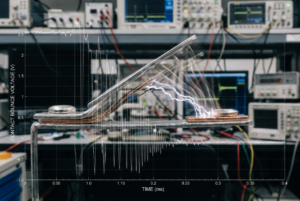
The problem arises because the electrical circuit is often already energized during this bouncing phase. Each time the contacts separate, a small electric arc is struck. In a typical bounce event lasting 2-5ms, there may be 3 to 10 individual micro-arcs.

Contact Bounce in Silver Alloys

Thermal and Mechanical Degradation

The cumulative effect of these micro-arcs is devastating for silver alloys. Localized melting and vaporization of the silver lead to material being transferred from one contact to the other, creating “pips” and “craters” that degrade the contact geometry. Furthermore, the high heat of the arc promotes the formation of non-conductive oxides on the contact surface, increasing contact resistance and heat generation.

The most dangerous consequence of contact bounce is “dynamic welding.” If the contacts rebound while the silver is in a molten state, they may fuse together as they re-close, causing the switch to fail in the “on” position.

The Role of Silver Alloys

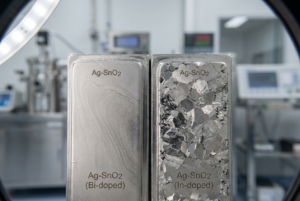
Different silver alloys respond to contact bounce in various ways. Silver Tin Oxide (AgSnO2) is the modern standard, offering superior erosion resistance and being less prone to material transfer during high-frequency bouncing. Silver Nickel (AgNi) is excellent for low-to-medium loads, but can suffer from higher erosion rates if bounce is not controlled.

Silver Alloy Contact Erosion

Strategies for Mitigation

Engineers employ several techniques to mitigate the effects of contact bounce:

  • Mechanical Damping: Designing contact springs and actuators with high internal damping to absorb kinetic energy faster.
  • Increased Contact Force: Higher closing force can reduce the amplitude and duration of the bounce.
  • Arc Suppression: Using RC snubbers or diodes to limit the energy of the arcs struck during separation.
  • Material Selection: Choosing alloys like AgSnO2 with specialized additives that increase the viscosity of the molten silver, reducing material splash.

Conclusion

Contact bounce is an inherent challenge in mechanical switching, but it is not an insurmountable one. By understanding the mechanical and thermal mechanisms at play, and by selecting high-performance silver alloy materials tailored to the application, engineers can significantly extend the reliability and service life of their electrical components.

24 5 月, 2026
In the precision wor…
阅读更多 →